Unexplained Stories
A Minnesota Deputy Chased a Light. He Woke Up 39 Minutes Later
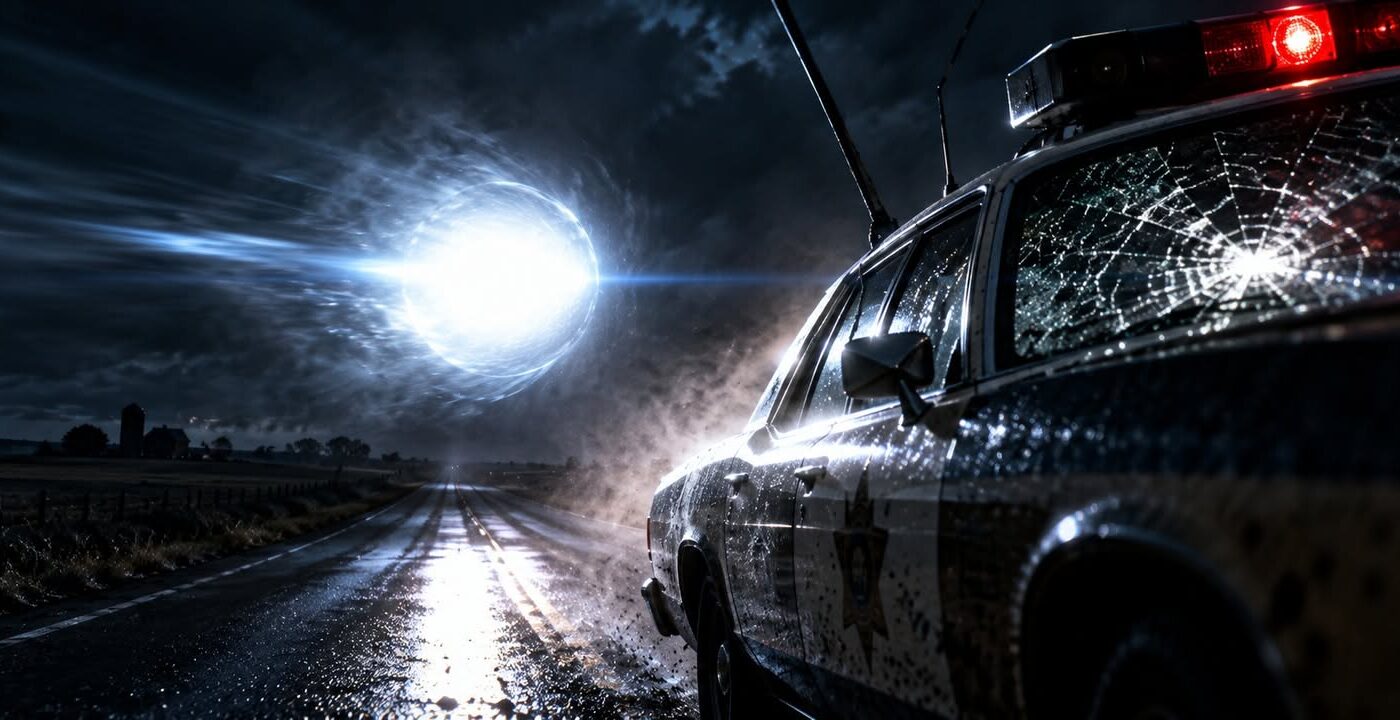
At 1:40 a.m. on August 27, 1979, Deputy Sheriff Val Johnson was driving along a lonely stretch of highway in northern Minnesota when he spotted a brilliant light ahead.
He thought an airplane might be in trouble, so he turned his patrol car toward it. But as he approached, the light suddenly rushed toward him.
His cruiser filled with blinding brightness. Johnson heard glass breaking, and everything went black.
When he regained consciousness, 39 minutes had passed. His patrol car was badly damaged, and he had no memory of what had happened during that time.
The strangest discoveries were still to come.
He Woke Up Sideways on the Highway
Johnson had been patrolling about ten miles west of Stephen, Minnesota, traveling from County Highway 5 onto State Highway 220. When he came to, his cruiser was stopped at an angle across the road, hundreds of feet beyond the point where he remembered the light approaching.
According to records held by the Minnesota Historical Society, the vehicle had traveled approximately 854 feet beyond the estimated point of the encounter. Johnson was disoriented, his eyes hurt, and he had a bump on his head. After gathering himself, he radioed for assistance.
Another deputy arrived and helped arrange for Johnson to be taken to a hospital in Warren.
Two Clocks Were Fourteen Minutes Slow
Investigators examining the incident discovered something remarkable about the timepieces Johnson had been carrying. His wristwatch and the electric clock in the patrol car were both fourteen minutes slow. They operated independently, with no shared mechanism that could explain why both displayed the same discrepancy.
The fourteen-minute difference didn’t match the 39 minutes Johnson couldn’t account for, leaving investigators with two separate puzzles. The clocks appeared to have lost exactly the same amount of time, while Johnson had been unconscious for considerably longer.
The Cruiser Had Taken a Beating
Johnson’s 1977 Ford LTD showed considerable damage. Its windshield was cracked, the hood was dented, and one headlight was broken. A hazard light was also damaged, while antennas mounted on the roof had been bent out of position.
A doctor treated Johnson’s eyes for irritation resembling welder’s burns, an injury associated with exposure to intense light. Sheriff Dennis Brekke launched an investigation and began looking for an explanation.
Since Johnson had initially suspected an aircraft, investigators contacted aviation authorities to check whether anything had been flying nearby. The Air Force and Federal Aviation Agency reported no known aircraft activity that matched his account. Investigators turned their attention to the physical evidence left behind.
Engineers Examined the Damage
Specialists from the Center for UFO Studies became involved, examining the vehicle and conducting magnetic tests. In November 1979, a metal engineer from Honeywell inspected the cruiser. He concluded that an electrical force or phenomenon appeared to have caused the damage.
That finding raised the possibility that Johnson had encountered something capable of affecting the car electrically. Researchers explored explanations ranging from unusual atmospheric activity to unidentified flying objects. But the deputy himself remained careful about what he claimed.
Johnson Never Claimed to See Aliens
As news of the incident spread, Johnson became the subject of national attention. He appeared on Good Morning America and participated in interviews about his experience.
Unlike some famous UFO witnesses, he didn’t describe a spaceship, strange occupants, or an encounter with beings from another world. His account remained focused on the light and its effects.
Reporters contacted the sheriff’s office, researchers wanted to discuss the case, and curious people began calling Johnson’s family. His wife later described how the constant telephone calls were interfering with their lives.
Eventually, the family moved from Minnesota to Wisconsin. Although Johnson returned to ordinary life, the incident continued attracting attention among people interested in unexplained encounters.
The Patrol Car Became a Museum Exhibit
The Marshall County Historical Society in Warren eventually preserved Johnson’s 1977 Ford LTD. Rather than repair the vehicle and return it to service, the society kept its unusual condition as part of the exhibit.
Decades later, the cruiser became one of the museum’s best-known attractions. Visitors could examine it and learn about the investigation that followed the encounter.
The damaged antennas remained bent above the roof.
And two clocks had once stopped agreeing with the rest of the world.