Unexplained Stories
Two Women Walked Into the Gardens of Versailles and Found Another Century
On August 10, 1901, two English women were walking through the gardens of Versailles when they began noticing things that didn’t belong. The gardeners wore clothing from another century, the paths seemed unfamiliar, and an eerie silence had settled over the trees.
What had started as an ordinary afternoon visit was becoming increasingly strange. The women had arrived expecting to explore one of France’s most famous royal estates.
But after taking a wrong turn on their way to the Petit Trianon, they found themselves surrounded by people and places they couldn’t explain. Neither understood what was happening, although both began to feel that something was terribly wrong.
A Wrong Turn in the Gardens
Charlotte Anne Moberly and Eleanor Jourdain were respected English academics. Moberly was the principal of St Hugh’s College at Oxford, while Jourdain was preparing to become her deputy.
The women were visiting France together and had decided to spend an afternoon at Versailles. After touring the palace, they headed toward the Petit Trianon, a smaller château once associated with Queen Marie Antoinette.
Neither knew the grounds very well, and they eventually wandered away from the main path. Instead of reaching their destination, they found themselves walking through an unfamiliar part of the gardens.
Ahead, they noticed two men standing near a wheelbarrow and a spade. Both wore long grayish-green coats and small three-cornered hats, clothing that seemed out of place for ordinary gardeners in 1901.
When the women asked for directions, the men pointed them farther along the path. Jourdain also remembered seeing a woman and a young girl outside a nearby cottage.
The woman appeared to be handing a jug to the child, and their clothes seemed old-fashioned. Neither paid much attention at first, although the scene would later become important when they tried to reconstruct their afternoon.
As they continued, a strange feeling began creeping over them. Moberly described an overwhelming sadness, while Jourdain recalled a similar sense of discomfort.
The surrounding trees appeared flat and lifeless, almost like scenery in a painting. There was no movement in the branches, and the ordinary sounds of the gardens seemed to have disappeared.
The women continued along the path, increasingly uncomfortable with their surroundings. They still hadn’t found the Petit Trianon, and neither wanted to remain in the wooded area any longer than necessary.
The Man Beside the Kiosk
The path eventually brought them to a small circular pavilion beneath the trees. Beside it sat a man wearing a dark cloak and a broad-brimmed hat. When he turned toward them, Moberly was frightened by his appearance.
His face looked dark and rough, and Jourdain later described his skin as heavily marked by smallpox. The man watched them without speaking, making the women reluctant to approach him. They didn’t know which direction to take, but neither wanted to ask him for help.
Suddenly, another man appeared, hurrying toward them as though he’d been running. He wore a cloak and a large hat, with dark curly hair visible beneath it. He seemed anxious to get their attention and began speaking rapidly in French.
The women couldn’t understand everything he said, but his warning was clear enough. He pointed them away from the path they were about to follow and directed them toward another route. They took his advice and hurried away from the silent stranger.
Following his directions, they crossed a small rustic bridge over a narrow stream. Ferns grew among the stones beneath it, and the path continued toward the château.
After the strange encounters in the woods, the women were relieved to be approaching their destination. But Moberly was about to see something that Jourdain would later insist had never been there.
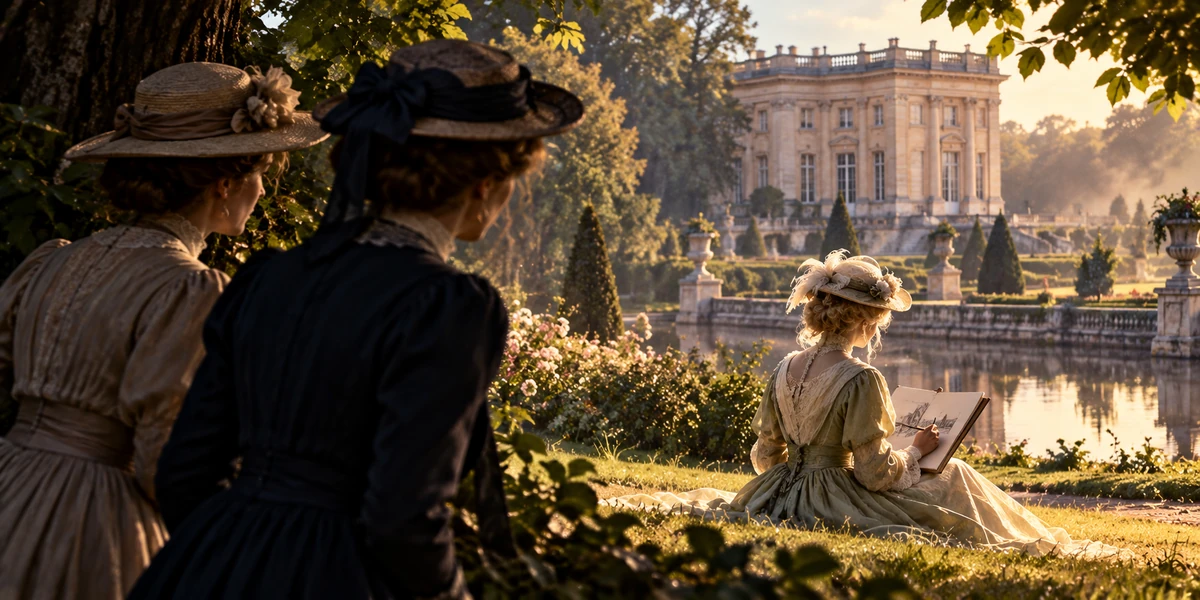
It happened near the terrace of the Petit Trianon, where the gardens opened into a more familiar setting. A woman was sitting alone on the grass, occupied with a drawing.
The Woman Who Wasn’t There
Moberly noticed that the woman was holding a piece of paper at arm’s length, as though sketching something in front of her. She had fair hair beneath a white hat and wore a light summer dress with a pale green covering around her shoulders.
Her clothing looked as though it belonged to an earlier time. As the women passed, the seated figure turned and looked directly at Moberly.
Something about the encounter made her uncomfortable, although the woman hadn’t spoken or approached them. Moberly continued walking, eager to reach the château.
The two visitors eventually found the proper entrance, where a young man helped them inside. There were tourists and members of a wedding party nearby, and everything seemed normal again. The strange atmosphere they’d experienced in the gardens had disappeared.
They returned to Paris without discussing everything they’d seen. Both remembered feeling uncomfortable during the walk, but neither knew what to make of the experience. It wasn’t until about a week later that Moberly finally brought up the subject.
She asked Jourdain whether she thought the Petit Trianon might be haunted. Jourdain answered yes, admitting that she’d experienced similar feelings during their visit. They began comparing memories and discovered that several details had stayed with them.
Months later, Moberly mentioned the woman she’d seen sitting near the terrace. Jourdain was surprised because she had no memory of anyone sitting there. Although they’d walked past the same spot together, only Moberly remembered seeing the woman in the old-fashioned dress.
The Paths That Had Disappeared
The women eventually returned to Versailles, determined to retrace their original route. But when they searched the gardens, several familiar landmarks seemed to have disappeared.
They couldn’t find the circular kiosk or the little bridge they remembered crossing. The paths also looked different from the ones they’d followed in August.
They searched for the buildings and features they’d seen, hoping to work out exactly where they’d walked. The more they examined the grounds, the harder it became to match their memories with what was there.
Jourdain made another visit in January 1902 and described further strange experiences. She saw workers in unfamiliar clothing who disappeared when she looked away.
She also remembered hearing distant music, although she couldn’t locate anyone performing it. The women began researching the history of the gardens, studying old plans and descriptions of Versailles during the eighteenth century.
They discovered references to buildings and decorative features that no longer existed. Among them was a Chinese-style pavilion that reminded them of the circular structure they’d seen beneath the trees.
Their research eventually led them to Marie Antoinette, who had spent considerable time at the Petit Trianon before the French Revolution. Moberly wondered whether the woman she’d seen sketching near the terrace could have been the queen herself.
The clothing, the setting and the old garden features all seemed connected to the royal estate’s past. In 1911, Moberly and Jourdain published their experience in a book called An Adventure.
They used the names Elizabeth Morison and Frances Lamont, presenting their memories alongside the historical research they’d conducted. The book attracted considerable attention, introducing readers to one of the strangest stories ever associated with Versailles.
The story continued circulating long after both women had died, becoming one of the most famous encounters of a time slip. Researchers and visitors returned to the gardens, examining old maps and searching for the places the women had described.