Unexplained Stories
The Devil’s Footprints Appeared on Rooftops and Behind Locked Gates in Devon
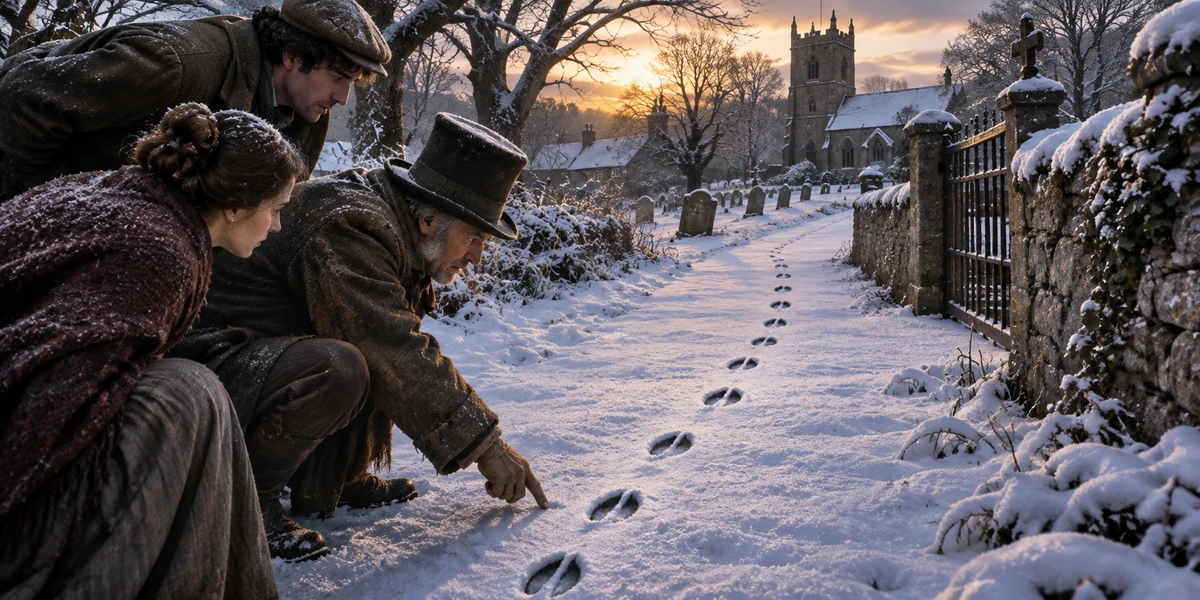
On the morning of February 9, 1855, people in Dawlish, England, discovered strange marks running through the fresh snow. They looked like tiny horseshoes, placed one directly in front of another.
A trail passed through the churchyard and between the graves, leaving residents wondering what had visited during the night. The tracks also appeared in gardens surrounded by high walls, on rooftops, and across places that seemed impossible for an ordinary animal to reach.
Some of the gardens had been locked all night, and the snow around the gates remained untouched. Whatever had left the marks had traveled through the town without anyone seeing it.
A Strange Morning in Devon
Devon was experiencing one of its coldest winters in years. Rivers had frozen, and snow covered much of the countryside during the evening of February 8.
By the following morning, the strange impressions were clearly visible across the frozen ground. The tracks were small, measuring around three and a half inches long.
Each print was separated from the next by roughly a foot, forming a narrow line that resembled the tracks of a one-legged animal. Some people thought the shape looked like a donkey's hoof.
Residents began following the trails to see where they went. Some crossed open fields, while others continued along garden paths and through churchyards. People who spent their lives around farm animals had never seen anything quite like them.
The discoveries soon spread beyond Dawlish. People in Exmouth, Topsham, Lympstone, and other nearby communities began finding similar marks. By the time newspapers heard about them, the strange visitor had become the talk of the Devon countryside.
The Tracks Behind Locked Gates
In Exmouth, homeowners discovered hoof prints inside gardens surrounded by walls up to seven feet high. The gates had been locked overnight, and there were no obvious signs of anything climbing over them. Yet the little hoof-shaped marks continued across the snow inside.
Residents in Lympstone described similar discoveries. Tracks appeared on narrow walls, rooftops, and other places where an animal would have struggled to walk. One newspaper article described them continuing over haystacks and across a wall fourteen feet tall.
The distance covered was just as puzzling. Some reports placed the tracks across forty miles of countryside, while others suggested they went much farther. In several places, the spacing between the tracks appeared almost identical, even when the trail crossed an obstacle.
One witness described a line of footprints approaching a house before turning back through the garden. Another told of marks appearing inside an enclosed property without any sign of entry. With every new discovery, more residents joined the search for the animal leaving them.
The Search Through Dawlish
A group of tradesmen in Dawlish decided to follow the tracks themselves. Carrying weapons, they set out from the churchyard and continued through the grounds of Luscombe and Dawlishwater. They eventually reached Oaklands after traveling roughly five miles.
The men examined the route carefully, hoping to find where the creature had gone. Although the tracks continued through the countryside, they never found an animal responsible for them.
Other residents were becoming frightened by the discoveries. Groups gathered in Exmouth to inspect the marks, and some people were scared to leave their homes after dark.
The name Devil's Footprints soon caught on because the marks resembled small, cloven hooves. Reverend G.
M. Musgrave even discussed the creature during a sermon in Lympstone. By the middle of February, newspapers across England were covering the story of the mysterious tracks.
The Vicar Who Saved the Evidence
One man took a special interest in the mystery. Reverend Henry Thomas Ellacombe, the vicar of Clyst St George, had discovered unusual tracks around his own rectory.
People sent him letters describing what they had seen, along with drawings made from the impressions in the snow. Some sketches showed small differences in shape, giving him several examples to compare.
Ellacombe also collected material found near one of the trails and sent it to naturalist Richard Owen for examination. He kept the letters and drawings together with his other papers.
Those documents would eventually become an important record of what residents had witnessed. On February 24, The Illustrated London News published a drawing of the footprints. Readers could see the horseshoe-like impressions lined up one after another, complete with a scale showing their size.
The Papers That Survived
As the weather changed, the tracks disappeared from the fields, gardens, and rooftops. The searches ended, and life in Devon returned to normal.
Ellacombe kept his collection of letters and sketches, which eventually passed into storage with other historical papers. Almost a century later, researchers searching for surviving records came across his collection.
Among the documents were descriptions written by witnesses and drawings made while the impressions were still visible. The papers offered a closer look at the events than the newspaper stories alone could provide.