Unexplained Stories
A Meteorite Hit a Village in Peru. Then Hundreds of People Got Sick
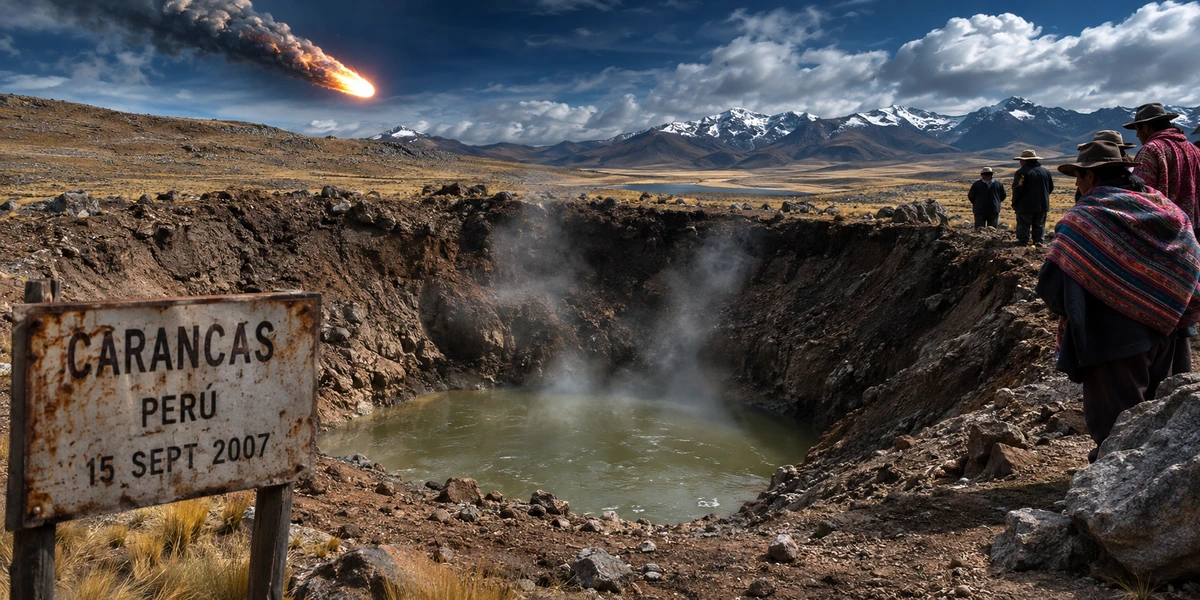
On September 15, 2007, people living near Carancas, a small community in southern Peru, saw something streak across the sky. Seconds later, an explosion shook the ground, sending residents outside to find out what had happened.
In a field not far from their homes, they discovered a large hole where there had been ordinary ground that morning. The opening was enormous, with freshly thrown earth scattered around its edges and muddy water collecting inside.
Witnesses described an unusual smell rising from the site, and some noticed what looked like vapor above the crater. News of the crater spread quickly through the community, drawing people who wanted to see what had fallen from the sky.
The Explosion That Shook Carancas
Carancas sits on the high Andean plateau near Lake Titicaca, not far from Peru’s border with Bolivia. The region is more than 12,000 feet above sea level, surrounded by open farmland and distant mountain ranges.
At approximately 11:45 that morning, the quiet landscape was interrupted by an explosion heard several miles away. People who reached the site found an opening roughly 44 feet across, although early news reports gave larger estimates.
Pieces of dark, unfamiliar stone lay scattered among the displaced earth, and water was already seeping into the crater. Some people began collecting fragments, unaware that the material would soon attract scientists and meteorite hunters from around the world.
Witnesses had seen a fireball, yet some scientists questioned whether a meteorite could have created a crater of that size. The object appeared to have struck with far more force than researchers expected from a relatively small stony meteorite.
People Began Getting Sick
As more residents gathered around the crater, stories of illness began spreading through Carancas. People complained of headaches, nausea, dizziness and vomiting, with several describing irritation to their eyes or skin.
Others spoke about a strong, unpleasant odor coming from the hole and wondered whether the impact had released something toxic. Within days, local health officials were dealing with a large number of complaints.
Early international reports described roughly 200 people experiencing symptoms, with other sources placing the number as high as 600. Many had approached the crater out of curiosity before anyone knew exactly what had fallen.
Now some feared they might have breathed something dangerous or carried contaminated dust back to their homes. Health workers began examining patients, and regional officials asked specialists to investigate the site.
Initial evaluations did not indicate that the patients were seriously ill, but the number of complaints raised concerns about possible exposure near the crater. Investigators needed to determine whether anything released by the impact could explain the symptoms.
The Rock That Should Have Broken Apart
Scientists eventually recovered enough material to identify the object as a genuine meteorite. Laboratory examination classified it as an H4–5 ordinary chondrite, a type of stony space rock containing iron-bearing minerals.
That identification answered the question of what had struck Carancas, but it created another mystery. Most small stony meteoroids are subjected to tremendous pressure as they race through Earth’s atmosphere.
Many break apart before reaching the ground, and their fragments lose much of their speed during the descent. Carancas had behaved differently, arriving with enough energy to blast out a crater several meters deep.
In 2008, researchers led by meteor physicist Peter Brown reconstructed the impact using eyewitness descriptions, seismic records and low-frequency sound measurements. They calculated that the original object weighed approximately three to nine metric tons and entered the atmosphere traveling around 12 kilometers per second.
Even after slowing dramatically, it struck the ground at an estimated speed of between 1.5 and 4 kilometers per second. Those findings helped explain the explosion and the unexpectedly large crater.
Researchers considered whether the meteorite had been unusually strong, allowing it to remain intact while other objects might have shattered. Carancas’s high elevation also meant the rock had passed through less dense atmosphere before reaching the surface.
What Was Coming Out of the Ground?
While scientists examined the meteorite, other investigators focused on the symptoms residents described. The foul smell pointed to gases escaping from the surrounding soil when the impact disturbed the ground.
Investigators considered hydrogen sulfide, especially because the crater had opened in wet sediments containing organic material. Other explanations included mineral-rich dust, gases released from groundwater and substances disturbed by the explosion.
Early investigators considered arsenic, but did not establish that arsenic poisoning had caused the illnesses. Residents also feared radiation, although ordinary meteorites are not expected to produce dangerous radioactive contamination. Peru’s Nuclear Energy Institute examined the area and found no unusual radiation.
The Investigation Continued
Long after the immediate health scare faded, Carancas remained an important site for meteorite research. Scientists studied the crater’s shape, examined fragments and compared their findings with recordings made by instruments hundreds of kilometers away.
The information helped researchers understand how a comparatively small stony object could survive atmospheric entry and strike the ground with such force. The investigation also brought new problems to the community.
Collectors began removing meteorite fragments, making it harder to preserve the original impact site for future study. Local people were suddenly living beside a scientific attraction that had appeared without warning and drawn attention from far beyond Peru.
Scientists eventually worked out the meteorite’s speed, composition and the tremendous force with which it struck the ground. They could even explain how the rock had survived its fiery plunge through Earth’s atmosphere, but they never explained what caused the wave of illness that followed.