Unexplained Stories
A Man in Black Phoned a Maine Doctor and Stood at His Door Minutes Later. Then He Made a Coin Vanish
At eight o'clock on the night of Saturday, September 11, 1976, Dr. Herbert Hopkins was home alone in Maine for the first time in a long while. His wife and children had gone to a drive-in movie.
Hopkins was not a UFO man, and he said so himself. The 58-year-old family doctor had studied hypnosis, and a local researcher named Shirley Fickett had talked him into running hypnosis sessions with David Stephens, who had lost hours of his life after a close encounter in October 1975 and, under hypnosis, described being taken and examined.
Hopkins kept the tapes of everything Stephens said.
The Call
The phone rang at eight. A man's voice said he was the vice president of the New Jersey UFO Research Organization, and wanted to talk about the David Stephens case. He asked if Hopkins was alone, and if it would be convenient to see him that evening. Hopkins told him to come right up — and never asked the man's name.
That was not like him — his home and office had been broken into twice, and he never saw anyone alone. He went to the back door to turn on the porch light — and the man was already coming up the porch stairs. Hopkins saw no car, and no one could have reached the house that fast from any phone. At the time, strangely, he did not think about it. He opened the door and let him in.
The Undertaker
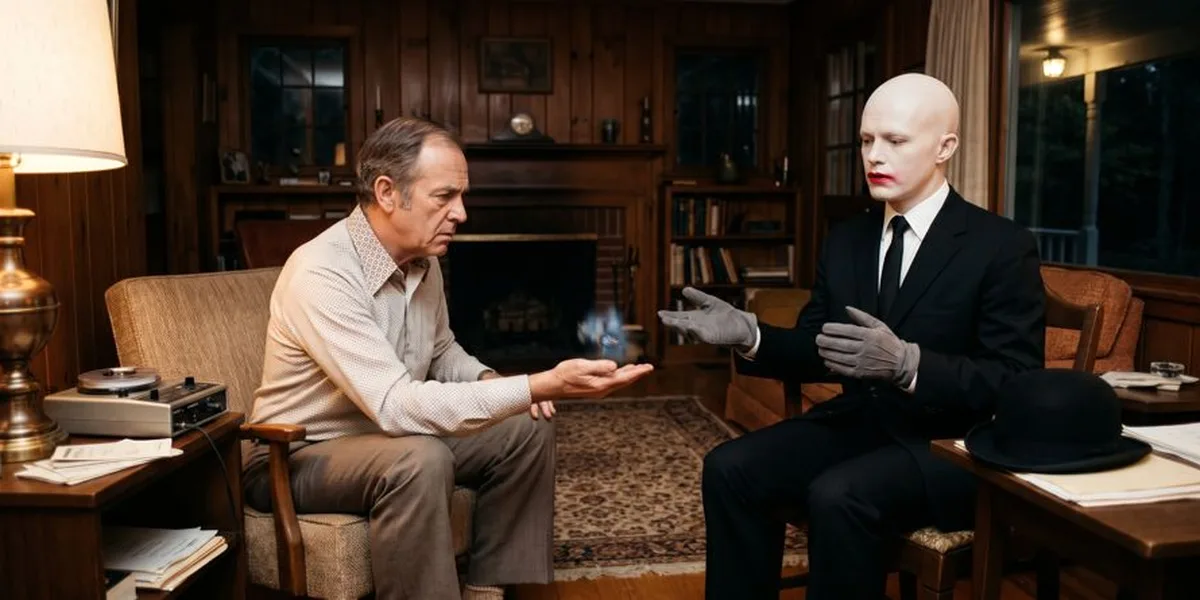
The visitor stood about five foot eight, in a black derby, black jacket, black tie, white shirt, black trousers and shoes. Hopkins' first thought was that he looked like an undertaker. His suit was immaculate — not a wrinkle in it, the crease in his trousers razor sharp. It fitted him the way clothes fit a store dummy, and when he sat down, the crease at his knees did not flatten.
He took off his hat, and he was completely hairless. No hair, no eyebrows, no eyelashes, not even hair follicles — his skin was dead white, his nose and ears small and set low. His lips were vivid red.
He spoke in a flat monotone, in flawless English with no accent, but with no sentences or phrases to it — just a series of words, in a voice Hopkins called scanning speech. His head never moved. It never turned, or nodded, or tilted once.
Hopkins told him about the Stephens case, and the man said, "That's just what I thought." As he listened, he brushed his lips with his fingers — he wore gray suede gloves — and the bright red came away on the glove: he was wearing lipstick, over a mouth that was a perfectly straight slit. It barely opened, and Hopkins never saw any teeth.
The Penny
Then the visitor told Hopkins that he had two coins in his left pocket. He was right — a dime and a penny. He told Hopkins to take one out and hold it in his open palm. Hopkins took the penny, the larger of the two, and held it out flat.
"Don't look at me," the man said. "Look at the coin." The shiny new penny turned bright silver as Hopkins watched. Then it turned light blue, and then it began to blur — his hand stayed in sharp focus, but the coin would not come into focus.
It went round, like a little blue fuzzy ball. Then it turned vaporous, and faded away to nothing. He felt nothing and heard nothing while it happened. "That was a neat trick," Hopkins said, and asked the man to make it come back. The man said, "Neither you nor anyone else on this plane will ever see that coin again" — and Hopkins noted the word: plane, not planet.
What the Visitor Wanted
Then the visitor asked him if he knew why Barney Hill died. Barney Hill, of the famous 1961 abduction case with his wife Betty, had been dead since 1969. Hopkins said he assumed a long illness. The man told him that was not the case: Barney Hill died because he knew too much.
Hopkins said he understood Hill had died of a heart attack. That was wrong too, the visitor told him. Barney Hill died because he had no heart — just as Hopkins no longer had a coin.
That scared him. Then the visitor got to the point: he told Hopkins he had tape recordings of the Stephens case, and letters as well and ordered him to destroy the tapes and every piece of UFO material he had, or suffer the same fate as Barney Hill.
He said he would know when Hopkins had done it. He did not say he would come back.
After He Left
As the visitor finished speaking, his speech began to slow down. He rose slowly and unsteadily and said, very slowly, "My energy is running low — must go now — goodbye." Hopkins opened the door for him. The man clung to the railing and went down the steps one foot at a time, both feet on each step, and walked unsteadily toward the corner of the building — away from the driveway, where a hedge left no way through.
A very bright light was shining up the driveway, bluish-white and brighter than car headlights, and Hopkins took it for the man's car. He ran to the kitchen window to watch him leave — nothing there, no man, no light, no car — and he stood on the porch while two or three cars passed on the street, and the visitor never came out. "I didn't think to look up," he wrote later.
His wife and sons got home an hour and a half later to find every light in the house blazing, and Hopkins sitting at the table with a gun in front of him. His oldest son took a flashlight out to the driveway, and in the very middle of it were marks like the tread of a small caterpillar tractor, about four inches wide and a foot and a half long. No car could have made them — the driveway was too narrow for wheels to reach the middle — and they were too deep and sharp for a motorcycle.
By the next day they were gone, and nobody had used the driveway in between. His wife asked the question the family has repeated ever since: "Well, what good was the gun if he made a penny disappear?" The family urged him to do as the man said, and that night Hopkins did it. He erased the four tapes and destroyed them in the fireplace, burned his UFO articles and letters, and called Shirley Fickett to have her tell the National Enquirer to drop its story on the Stephens case.
"Oh, how I hated to destroy those tapes," he wrote. "They weren't hurting anyone, but I wanted to be safe, and I was really terrified." About a week later the nightmares started — the visitor's face growing bigger and closer — and they ran for about a week before they stopped. Then the phone trouble started: the line cutting off, clicks, sounds of an open line somewhere else, people breaking in on calls.
Thirteen Days Later
On Friday, September 24, Hopkins' daughter-in-law Maureen answered a call at half past seven. A man giving his name as Bill Post said he was a friend of a friend of her husband John, and asked if he and a companion could visit.
John met the pair at a McDonald's and brought them to the couple's mobile home. The man's car carried temporary New Jersey plates with no letters or numbers on them at all — just the words "Temporary, N.J., 1975." The two of them were in their mid-thirties and dressed about twenty years out of date. They walked with very short steps, leaning forward as if they were afraid of falling, and when the woman stood up, there seemed to be something wrong with the way her legs joined her hips.
The man did most of the talking, and most of it was questions — about their TV, their reading, and what John talked about with his father. The whole time, he kept pawing and fondling the woman beside him. He kept asking John if it was all right to do that, and whether he was doing it correctly.
When John stepped out of the room to answer the phone, the man asked Maureen to sit beside him. He asked her how she was made, and whether she had any nude pictures of herself. She told him certainly not.
He knew John was about to take up amateur radio, with no equipment anywhere in sight. He knew John had a trip to New Jersey coming up, and gave him a route of back roads and detours — roads John later found had been discontinued or rerouted years before.
When the woman stood up and said she wanted to leave, the man stood up too — and then did not move, no matter how many times she said it. At last she turned to John and said, "Please move him. I can't move him myself."
John told them they had better go, and suddenly the man left. The woman followed, walking in a perfectly straight line, right over the spot where he had been standing. They did not say goodbye.
A few weeks later, the man called Maureen. He apologized for anything he had done that seemed out of place, said it would not happen again, and asked if they could talk some more. She told him she wanted nothing to do with people like them. It was the last the family ever heard from any of them.
Hopkins never saw his own visitor again. He had done everything demanded of him, and the demand had done its work — the tapes of everything David Stephens said under hypnosis were ash in a fireplace in Maine, and the Stephens case lost the best record it ever had.
What survived the fire was the one thing the visitor never asked for — Hopkins' memory of the night, written down. Before the year was out, researchers had gone over every piece of it. Fifty years on, it is still the most detailed telling of a Man in Black visit ever put on paper — from a doctor who said that before that night, he had never even heard of the Men in Black.
The organization his visitor claimed to speak for was looked for. There is no New Jersey UFO Research Organization. There never was. And the penny was never seen again — by Hopkins, or by anyone else on this plane.