Cryptids & Creatures
The Indian Army Found 32-Inch Footprints in the Himalayas. It Said Yeti
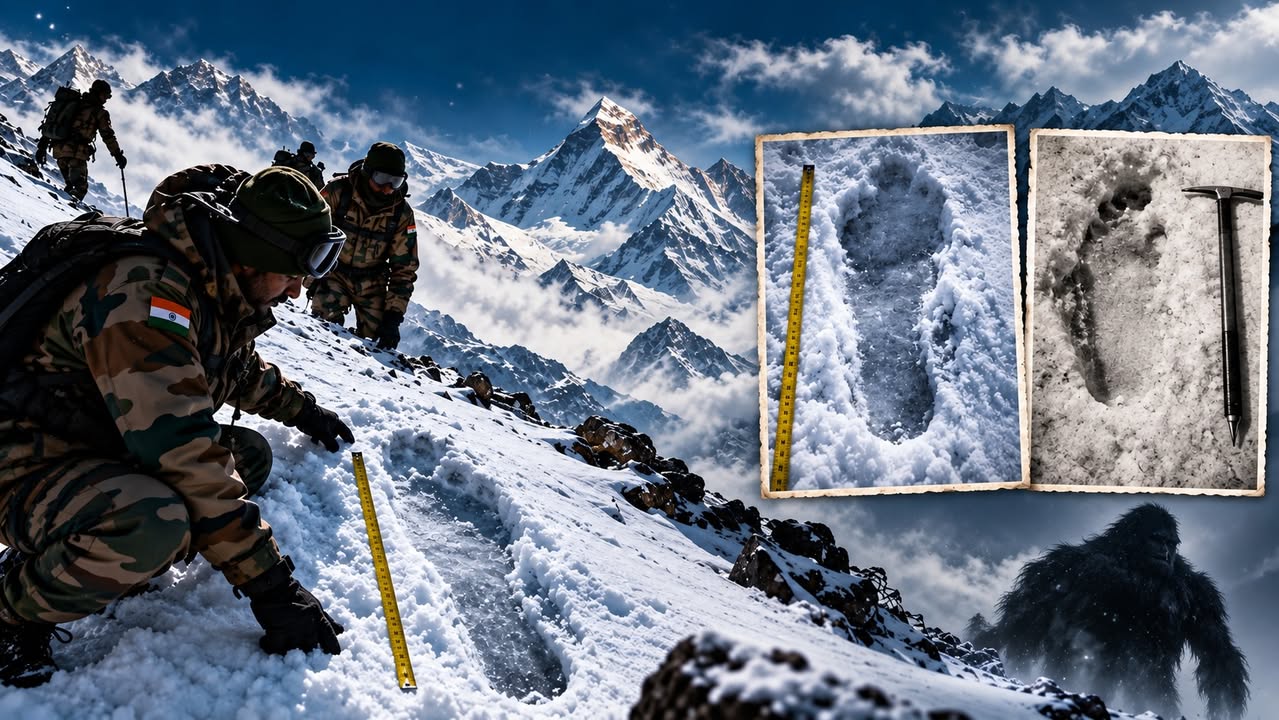
On April 9, 2019, an Indian Army mountaineering team was traveling through the snow near Makalu Base Camp in Nepal when its members spotted something extraordinary. A trail of enormous impressions stretched across the mountainside.
The soldiers stopped, took photographs, and measured the marks. Some were approximately 32 inches long and 15 inches wide.
Twenty days later, the Indian Army posted the photographs on its official Twitter account with an astonishing announcement. Its expedition had discovered what it called the mysterious footprints of the mythical Yeti.
The Announcement Came From the Indian Army
This wasn’t an anonymous climber telling a strange story years after returning from the mountains. It was an official statement from one of the world’s largest militaries.
On April 29, the Indian Army shared photographs showing deep impressions in the snow, along with soldiers examining the trail. The announcement also mentioned that the Yeti had previously been reported in the Makalu-Barun region.
The photographs quickly attracted international attention. A modern military organization had publicly associated its own field observations with one of the world’s most famous legendary creatures. Army sources later explained that the expedition had collected photographs and video and considered the evidence before releasing it publicly.
The soldiers hadn’t rushed straight from the mountain to social media. They had kept the discovery to themselves for nearly three weeks.
The Footprints Were Enormous
A 32-inch footprint is more than two and a half feet long, far larger than an ordinary human foot. The impressions also appeared along a trail rather than as one isolated depression. Whatever had passed through the area had left a series of marks substantial enough to catch the attention of experienced mountaineers.
But the team never reported seeing the animal responsible. By the time the soldiers arrived, the snowy landscape was empty.
The photographs showed the tracks, their measurements, and the surrounding terrain. The creature itself was nowhere in sight.
That absence gave the discovery an especially intriguing quality.
Nepal’s Army Offered Another Explanation
The announcement soon produced disagreement between two military organizations. While the Indian Army associated the prints with the Yeti, an officer from Nepal’s army offered a different explanation. According to the Nepali account, local people and porters familiar with the area believed the tracks belonged to a wild bear.
Bears inhabit Himalayan regions, and their footprints can take on unusual shapes in snow. As temperatures change, snow can melt or collapse around an impression, making it appear much larger. A bear may also step partly into a mark left by another foot, producing a long shape that looks different from an ordinary paw print.
India’s expedition had encountered something it considered extraordinary. Local observers reportedly recognized the signs of a familiar mountain animal.
Neither group had seen the creature leave the tracks.
Makalu Had a Long Yeti History
The location added another layer to the story. Makalu rises more than 8,400 meters near the border between Nepal and Tibet. Its surrounding landscape includes glaciers, deep valleys, and remote terrain where wildlife can be difficult to observe.
Stories about mysterious mountain beings have circulated through Himalayan communities for generations. During the twentieth century, Western mountaineering expeditions helped bring those accounts to international audiences.
One particularly famous incident occurred in 1951. British mountaineer Eric Shipton photographed an enormous footprint on the Menlung Glacier, placing an ice axe beside it for scale. His photograph became one of the most recognizable images associated with the Yeti legend. Nearly seventy years later, another expedition was photographing a mysterious Himalayan track with measuring equipment beside it.
The Photographs Went Around the World
The Indian Army’s announcement spread rapidly across news websites and social media. Some people were fascinated that the military had used the name Yeti. Others found the announcement amusing, and jokes quickly appeared online.
Army sources defended the decision to share the discovery. They argued that the expedition had documented something unusual and that releasing the material would allow other people to examine it. Meanwhile, the controversy introduced millions of people to Makalu’s remote mountain landscape and its long association with Yeti stories.
The photographs also created an unusual problem for anyone hoping to investigate further. The expedition had already left the site, and the snow wouldn’t preserve the impressions indefinitely.
The Trail Had an Unusual Pattern
One detail drew particular attention from people examining the photographs. The impressions appeared to form a single line.
Most people imagine footprints appearing in alternating left-right pairs. The trail photographed by the soldiers looked different.
That arrangement encouraged speculation about the animal’s movement and how the marks had formed. In deep snow, an animal’s feet can land close together or overlap, creating a track pattern that looks surprising when viewed later.
But the photographs offered only a frozen glimpse of whatever had crossed the mountainside. The soldiers had photographed an enormous trail.
Nobody had photographed its maker.
The Mountain Kept Its Secret
The Indian Army’s discovery joined a long history of unusual footprints reported in the Himalayas. Like Eric Shipton’s famous 1951 photograph, the images continued circulating long after the people who took them had descended from the mountains. Whatever crossed the snow near Makalu Base Camp on April 9 had already moved on.
The soldiers had arrived in time to see its tracks.
They were too late to see where it went.