
Unexplained Stories
Divers Found a 200-Foot Object in the Baltic Sea. They Said Their Electronics Died Above It
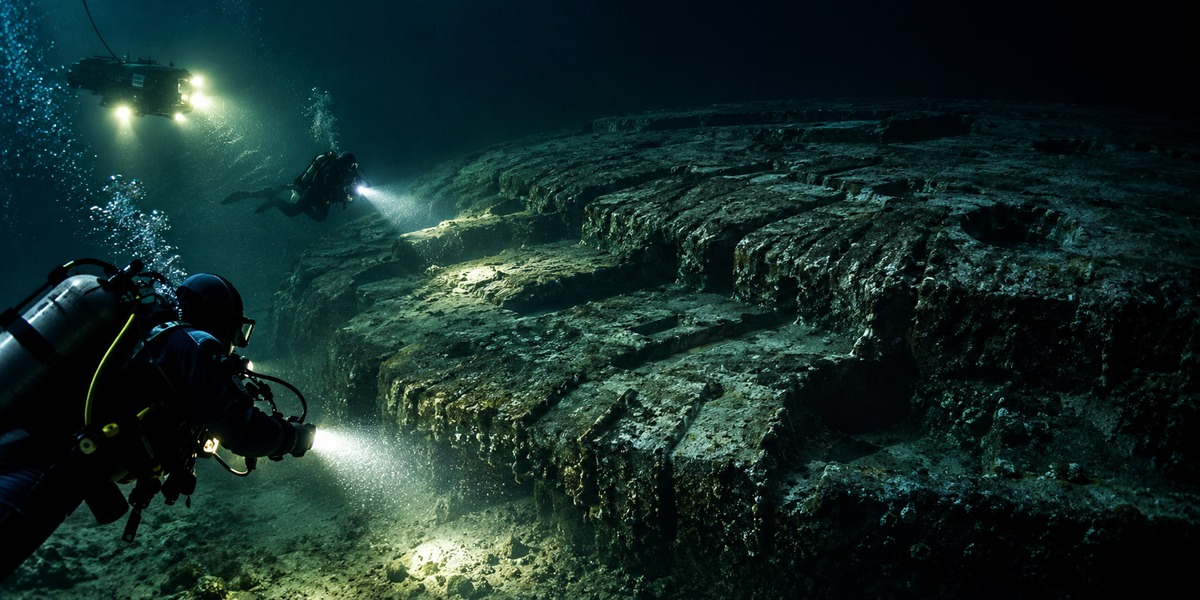
In June 2011, a Swedish treasure-hunting team was searching the Baltic Sea for shipwrecks when something unexpected appeared on their sonar screen. Sitting nearly 300 feet below the surface was an enormous, roughly circular shape.
The team, known as Ocean X, had spent years looking for sunken ships and valuable cargo. But this looked nothing like the wrecks they were accustomed to finding. It measured about 200 feet across, and a long mark appeared to stretch away from it along the seabed.
Whatever they had found, they wanted a closer look.
A Shape Nobody Expected
Ocean X founders Peter Lindberg and Dennis Åsberg were working in the Gulf of Bothnia, between Sweden and Finland. Their equipment used sound waves to create pictures of the seafloor, revealing objects that would otherwise be hidden in the darkness.
The image showed a broad, disc-shaped formation with an oddly regular outline. The long mark nearby made it look almost as though something enormous had slid across the seabed before coming to a stop.
When the team released the image, it quickly spread around the world. People compared the shape to the Millennium Falcon from *Star Wars*, while others wondered whether it might be a crashed flying saucer or the remains of some forgotten structure.
There was even another unusual shape nearby, which only added to the excitement. The team had plenty of theories to consider, but they needed to get down there and see what was actually on the bottom.
The Divers Went Down
In June 2012, Ocean X returned to the site with divers and equipment for a closer examination. The formation lay roughly 260 to 300 feet underwater, where the Baltic was cold, dark and difficult to explore.
Visibility was poor, and the divers couldn’t see the entire formation at once. They had to examine individual sections, following the surface and trying to understand how everything fitted together.
What they described was fascinating. The formation appeared to be raised above the surrounding seabed, with rounded sides and an uneven top. Some sections looked almost like steps, while others contained grooves and unusually straight edges.
The divers also reported an opening near the top and patches of dark material that resembled soot. At close range, parts of the formation seemed almost deliberately shaped.
Stefan Hogerborn, an experienced professional diver, said he had never encountered anything quite like it. Peter Lindberg was equally intrigued by the way certain sections appeared to fit together.
With limited visibility, neither man could get a complete view of the enormous formation. They would have to rely on their underwater observations, photographs and sonar recordings to understand its shape.
They Brought Pieces Back
The expedition recovered rock samples from the site and sent some of them for examination. Among the people who studied the material was Volker Brüchert, a geologist at Stockholm University.
Most of the samples were granite, gneiss and sandstone, all common in the Baltic region. Another piece appeared to be volcanic rock, which attracted additional attention.
Brüchert believed the rocks could be explained by the area’s Ice Age history. Thousands of years earlier, enormous glaciers had covered the region, dragging stones across the landscape and leaving them behind as the ice melted.
That gave the team an explanation for at least some of what they had brought up. But Lindberg and Åsberg were still interested in the formation’s enormous size and the features their divers had described.
The investigation continued, with Ocean X examining new images and considering how to return with better equipment.
Fourteen Years Later, They Went Back
The Baltic Sea anomaly remained a subject of fascination long after the original expeditions. In 2025, a new international research effort began investigating the site using equipment far more advanced than what Ocean X had available in 2011.
The Society for UAP Studies announced its involvement, supporting research that brought together specialists from several scientific fields. The project aimed to gather detailed measurements of the formation and the seabed around it.
Plans included improved sonar mapping, instruments capable of examining what lay beneath the surface, and equipment that could help create three-dimensional models of the area. Dennis Åsberg later confirmed that he had returned to the location twice during 2025. This time, he was working alongside researchers from several countries aboard a vessel equipped for scientific surveying.
For Åsberg, it was an opportunity he had wanted for years. Instead of depending on scattered underwater observations, the researchers could begin building a much more complete picture of the formation.
The team gathered new measurements, and further work was being discussed for 2026. But the renewed expedition also brought attention back to one of the strangest stories from the original dives.
Something Was Interfering With Their Equipment
During the 2012 expedition, the Ocean X crew reported something peculiar happening aboard their vessel. According to diver Stefan Hogerborn, electrical equipment began behaving strangely whenever the boat was positioned above the formation.
Cameras reportedly stopped working, despite functioning normally elsewhere. The crew also experienced problems with their satellite phone, which suddenly seemed unable to operate.
Hogerborn had worked as a professional diver for about 20 years. He knew that equipment could malfunction at sea, but the way these problems appeared to happen in one particular location caught his attention.
The satellite phone was especially puzzling. It wasn’t underwater, and the crew weren’t attempting to use it at any great depth. They were aboard their vessel, floating above the mysterious shape.
Hogerborn said the crew began wondering whether their position had something to do with the failures. Rather than simply accepting that the phone was broken, they decided to try something.
They moved the boat away from the formation, travelling roughly 200 metres across the water. Once they were clear of the location, they checked the satellite phone again.
It was working.
They steered back over the formation, and the phone went dead again.