
Unexplained Stories
Every 44 Minutes, Something 15,000 Light-Years Away Turns On
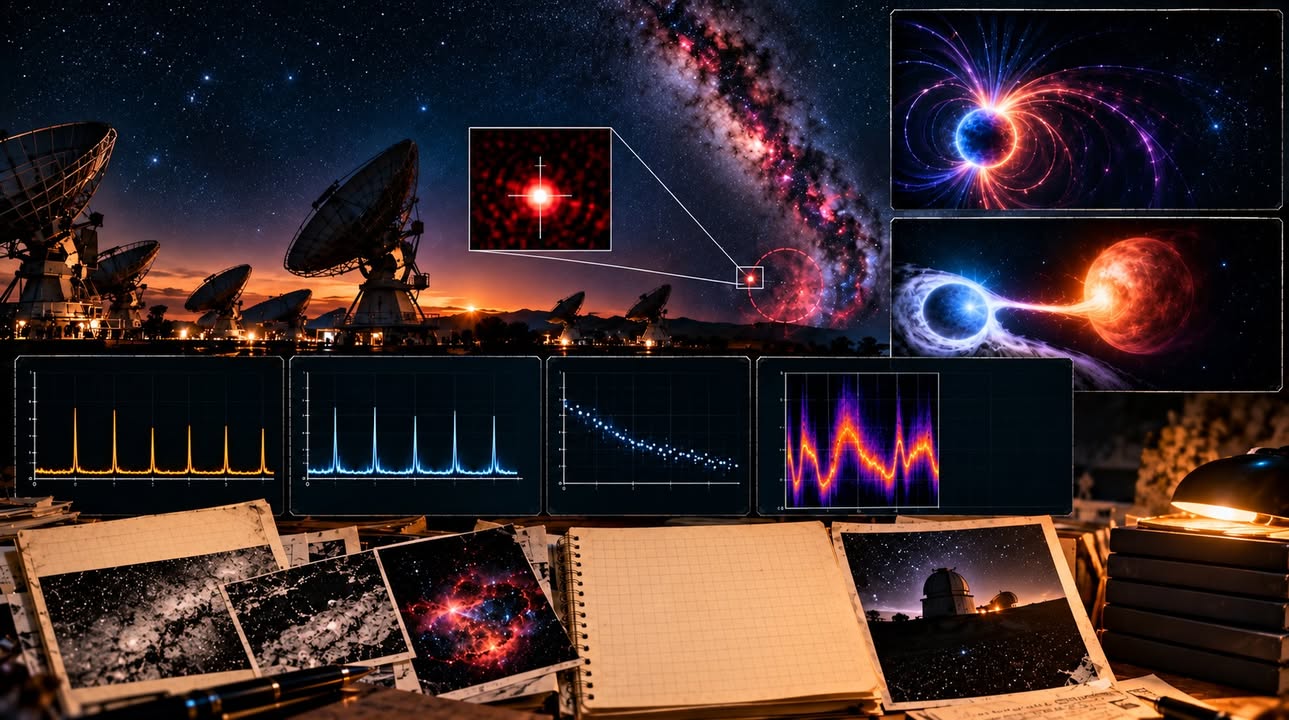
Astronomers using a radio telescope in Australia picked up something strange coming from deep inside our galaxy. A powerful burst of radio waves appeared, stayed bright for about two minutes, and faded away. Roughly 44 minutes later, it happened again.
The signal was coming from something about 15,000 light-years from Earth. Scientists named it ASKAP J1832−0911, but they had no idea what was producing it. The object was behaving unlike anything they had encountered before.
The Signal Was Unusually Slow
Astronomers already knew about pulsars, the remains of dead stars that spin rapidly and send beams of radiation through space. Some pulse hundreds of times every second. But this new object was taking nearly three-quarters of an hour between bursts.
The signals were also extremely powerful and showed signs of strong magnetic activity. Whatever was producing them appeared to have an enormous magnetic field. Scientists began considering different kinds of stars that might behave this way.
There was something else unusual about the discovery. When researchers checked older telescope observations of the same part of the sky, they couldn’t find the source. It appeared to have become active after years of going unnoticed.
Another Telescope Had Spotted It
While studying the radio signals, researchers discovered that NASA’s Chandra X-ray Observatory had been watching the same region. Chandra detects X-rays, a different kind of radiation that can come from extremely hot or energetic objects in space. Its observations gave astronomers another way to investigate the mystery.
When they compared the data, they found something remarkable. X-rays were coming from the same location, growing brighter and fading on the same schedule as the radio signals. Both appeared to be coming from a single source.
Scientists had never seen this combination before in an object with such a long interval between radio bursts. The discovery, announced in May 2025, gave them a whole new set of clues. It also made finding an explanation considerably harder.
The Bursts Started Changing
As astronomers continued studying the object, they noticed that the individual bursts weren’t identical. Some were brighter than others, and smaller patterns appeared within the radio signals. Over several months, the overall brightness also dropped dramatically.
Researchers examined another unusual feature of the radio waves. They were polarized, meaning their electromagnetic vibrations followed particular directions. By studying changes in that polarization, scientists could learn about the magnetic fields surrounding whatever was sending the signals.
Those measurements revealed patterns that changed over days and months. Even the direction of the polarization shifted as the bursts passed through. Astronomers began looking for something that could produce powerful radio waves while its magnetic surroundings kept changing.
Scientists Considered Dead Stars
One possibility was a magnetar, the remains of a massive star with an incredibly powerful magnetic field. Magnetars can produce intense bursts of radiation, making them an obvious place to start. But the extremely slow timing and unusual changes in the signals were difficult to explain using known magnetars.
Another possibility involved a white dwarf, the small, dense remains of a star that has exhausted its fuel. A white dwarf can be roughly the size of Earth while containing much of the mass of our Sun. Some also have powerful magnetic fields and orbit close to other stars.
That second possibility became especially interesting when researchers considered what might happen if a white dwarf had a companion. The two stars could interact in ways that produced unusual bursts of energy. A nearby star might also help explain why the signals kept changing.
A New Theory Emerged in 2026
In September 2026, a team led by Csanád Horváth proposed an explanation after studying roughly two years of radio observations. They suggested that ASKAP J1832 might be a pair of stars orbiting extremely close together. One would be a strongly magnetic white dwarf, with the other supplying material that the white dwarf could pull toward itself.
In this arrangement, the white dwarf wouldn’t necessarily spin at the same rate that the two stars orbited each other. That difference could change how gas moves between them and how their magnetic fields interact. The researchers found that such a system could account for several unusual features of the signals.
Astronomers call this type of system an asynchronous polar. The name sounds complicated, but the basic idea is straightforward: two stars moving together, with one spinning out of step. Their movements and magnetic fields could be responsible for the energy astronomers were detecting.
Astronomers Have Something New to Look For
The proposed explanation gives researchers a much clearer idea of what to search for next. If two stars are involved, their movements should leave signs that telescopes can detect. Scientists can look for changes caused by the stars orbiting one another and compare those with the radio observations.
One advantage is that this source keeps giving astronomers opportunities to study it. Many strange events in space happen once and disappear before scientists can examine them properly. ASKAP J1832 has already provided observations covering a long period, allowing researchers to follow changes that would otherwise be easy to miss.
Future observations may reveal whether a second star is involved and how the system produces its powerful bursts. Astronomers have several ways to investigate, including looking for movement in the surrounding material and changes in the radiation coming from the source.
Somewhere in that system, there may be a second star nobody has managed to see.
Its much louder neighbor has made keeping a secret pretty difficult.