
Unexplained Stories
Something Is Still Pulling the Outer Solar System Into Line
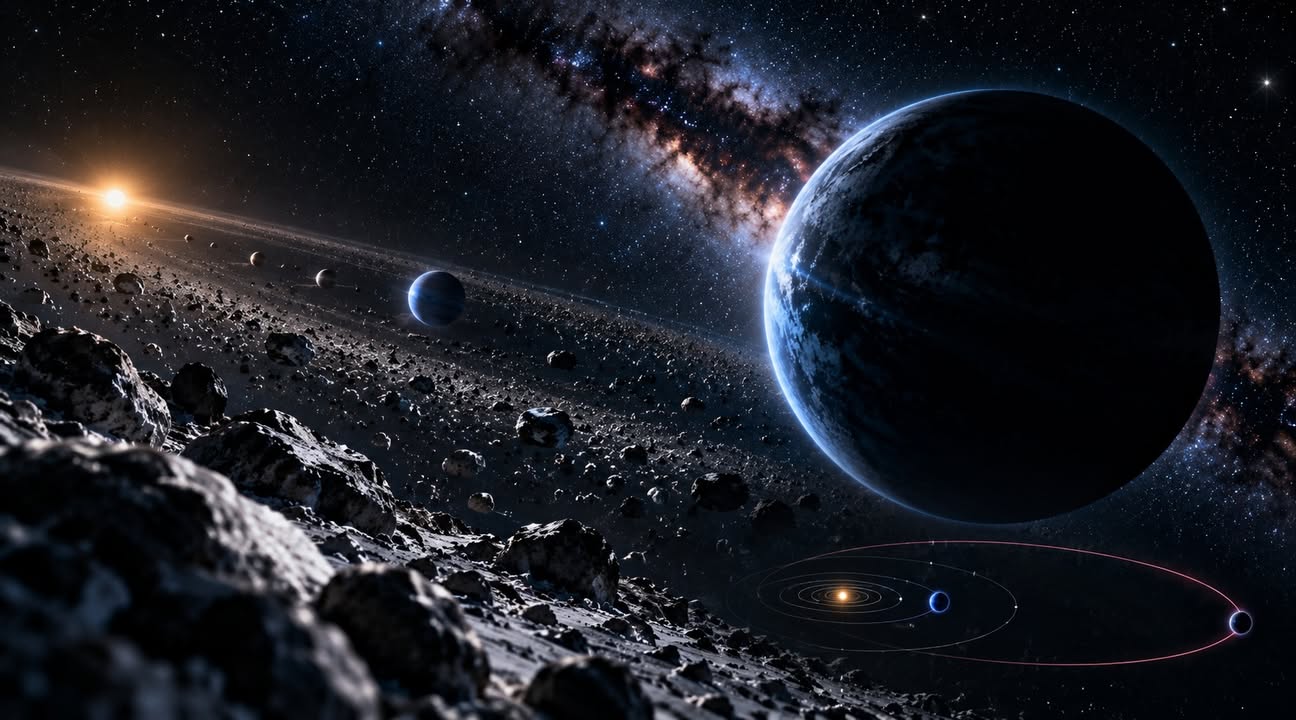
Far beyond Neptune, a handful of frozen worlds are traveling through space in a way that has astronomers puzzled.
Their orbits are enormous, carrying them billions of miles from the Sun. But when researchers began comparing their paths, they noticed something unusual: several seemed to be pointing in similar directions.
In 2016, two astronomers proposed an extraordinary explanation: a massive planet might be hiding in the outer solar system, using its gravity to influence objects that nobody had expected to behave this way. They called it Planet Nine, and they began looking for signs of where it might be.
The Clue Was in the Orbits
Caltech astronomers Konstantin Batygin and Michael Brown were studying some of the most distant objects known to orbit our Sun. These icy bodies travel along stretched-out paths, sometimes taking thousands of years to complete a single journey around the solar system.
What caught the researchers’ attention was how several of those paths appeared to line up. Instead of pointing in different directions, some seemed to follow a pattern that could be explained by the gravity of a large, distant planet.
Batygin and Brown began running computer simulations to see what kind of world might produce those movements. Their calculations suggested something far larger than Earth, traveling on an orbit well beyond Neptune.
It was an unusual way to search for a planet. Instead of spotting the world through a telescope, scientists were using the movements of other objects to work out where it might be.
A Giant World in the Darkness
In 2021, the researchers refined their predictions. Their updated calculations suggested Planet Nine might have roughly six times Earth’s mass, orbiting at an average distance of around 380 astronomical units.
One astronomical unit is the distance between Earth and the Sun, approximately 93 million miles. That would put the suspected planet so far away that sunlight reaching it would be incredibly weak.
Even a world several times heavier than Earth could appear as nothing more than a faint dot against the stars. Its orbit would also be enormous. A single trip around the Sun might take thousands of years, making its movement difficult to notice from Earth.
Astronomers had an idea of what they were looking for. Finding the right dot was another problem entirely.
Most of the Search Area Has Been Checked
Over the following years, researchers examined huge collections of telescope images. They used observations from Pan-STARRS, the Zwicky Transient Facility and the Dark Energy Survey to search for objects that might match the predicted planet.
In 2024, Brown, Batygin and astronomer Matthew Holman reported that their combined searches had ruled out approximately 78 percent of the possible locations and brightness combinations in their model. That still left a large amount of territory to investigate, including areas near the dense band of stars running through the Milky Way.
Those regions are especially difficult because countless distant stars fill the background. A faint planet could easily blend into the crowd. Astronomers would need repeated observations to identify a tiny point of light that slowly changed position.
Another Discovery Strengthened the Case
In 2024, Batygin and Brown worked with astronomers Alessandro Morbidelli and David Nesvorný to examine another group of distant objects. These bodies follow long orbits that cross Neptune’s path. The researchers wanted to see whether Planet Nine could help explain how those objects ended up moving through the solar system.
They ran computer simulations that included the known giant planets, the influence of nearby stars and other forces acting on distant objects. Models that included Planet Nine reproduced the observed movements much more successfully than those without it.
The findings gave the researchers another reason to continue searching. Their original idea had focused on one unusual group of distant objects, and now a different group appeared to offer additional clues.
The Outer Solar System Is Difficult to Study
One of the biggest problems facing astronomers is how little of the distant solar system we’ve actually observed. Many objects spend most of their time so far from the Sun that they’re extremely difficult to detect. Scientists usually discover them when their orbits bring them close enough for telescopes to pick up their faint reflected light.
That means astronomers might be seeing only a small portion of the objects that exist beyond Neptune. It also makes unusual orbital patterns difficult to interpret.
Some researchers believe the movements provide strong clues that Planet Nine exists. Others want to examine a much larger collection of distant objects before reaching that conclusion. A new observatory in Chile is expected to help answer those questions.
A Powerful New Telescope Begins Searching
On June 30, 2026, the Vera C. Rubin Observatory began its ten-year Legacy Survey of Space and Time. Located high in the mountains of Chile, the observatory uses an enormous digital camera to photograph wide sections of the southern sky.
Its approach is different from a telescope that spends hours examining one small area. Rubin repeatedly photographs large regions, building a record of how objects change and move over time. That makes it especially useful for detecting faint objects in the outer solar system.
The observatory could help the Planet Nine search in two ways. It might photograph the suspected planet directly, allowing astronomers to identify its movement against the background stars.
It could also discover many previously unknown icy worlds, giving researchers more orbits to compare with the predictions. Either discovery would provide valuable new information about what lies beyond Neptune.
A New Chapter in the Hunt
The Rubin Observatory’s survey is designed to continue for ten years, giving astronomers a long record of the changing sky.
As the observations accumulate, scientists will be able to compare images taken months or years apart. That could make all the difference when searching for something that moves almost imperceptibly from our point of view. The telescope’s powerful camera may also reveal objects nobody was specifically looking for, opening up other areas of research.
Astronomers have already discovered distant worlds in places that once seemed almost empty. There may be much more waiting beyond the last known planet.
And somewhere in those new images, one tiny dot could change the map of our solar system.