Unexplained Stories
Something From Another Star System Flew Past the Sun
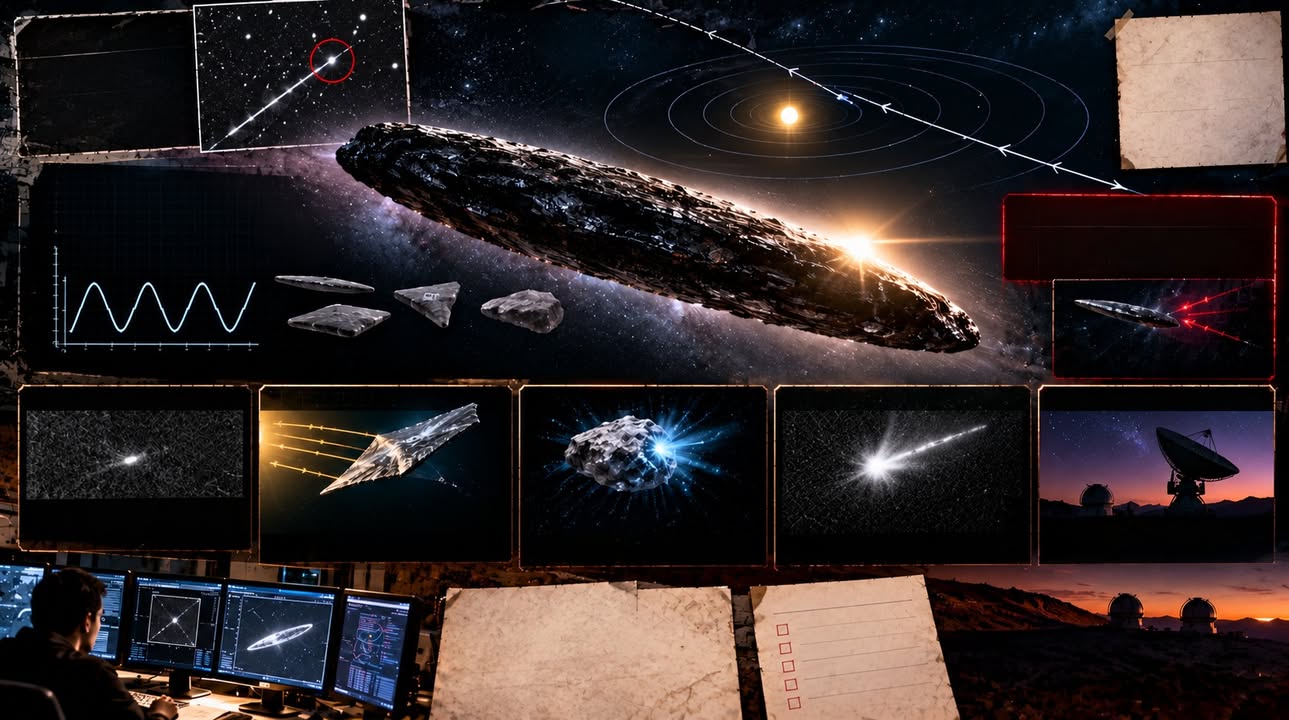
On October 19, 2017, astronomer Robert Weryk was examining telescope images from Hawaii when he noticed a faint object moving through space. At first, it looked like another asteroid passing through our solar system. But when astronomers calculated its path, they realized they’d found something extraordinary.
The object was traveling too fast to be held by the Sun’s gravity. It had come from somewhere beyond our solar system, making it the first confirmed visitor from another star system. Scientists named it ‘Oumuamua and immediately began trying to learn everything they could about it.
It Was Already Leaving When We Found It
By the time astronomers discovered ‘Oumuamua, it had already passed its closest point to the Sun more than a month earlier. It was moving away quickly and becoming fainter every night. Telescopes around the world began tracking it before it disappeared from view.
One of the first surprises came from changes in its brightness. As ‘Oumuamua tumbled through space, the amount of sunlight it reflected changed dramatically. Scientists suspected it had an unusually long, narrow shape, although a broad, flattened body could also explain the observations.
Nobody managed to photograph its surface. The familiar pictures showing something resembling an enormous space cigar are artists’ illustrations based on telescope measurements. Astronomers could only observe a distant point of light and work out what its changing brightness might mean.
Something Was Giving It an Extra Push
As researchers followed its movements, they noticed that ‘Oumuamua wasn’t traveling quite as expected. The Sun’s gravity accounted for most of its motion, but there appeared to be another small force pushing it away.
In 2018, an international team led by Marco Micheli published its findings in Nature. Using observations from the Hubble Space Telescope and observatories on Earth, the researchers confirmed that the extra acceleration was real. Something besides gravity was affecting the object’s journey.
Comets sometimes behave this way. When sunlight warms their frozen surfaces, gas escapes into space, giving them a gentle push. But ‘Oumuamua didn’t have the fuzzy cloud of dust or visible tail astronomers normally associate with an active comet.
That left scientists trying to explain how something could be pushed through space without showing any obvious signs of releasing material.
An Idea That Made Headlines
Astrophysicist Avi Loeb and researcher Shmuel Bialy explored another possibility. They wondered whether sunlight itself could be responsible for the acceleration. Their calculations suggested that an extremely thin object with a large surface area might experience enough pressure from sunlight to explain the movement.
The idea resembled a solar sail, a lightweight structure that uses sunlight to propel a spacecraft. Solar sails are a real technology that scientists have experimented with for years. Loeb and Bialy’s proposal raised the possibility that ‘Oumuamua might have a similar shape.
The suggestion attracted worldwide attention, especially because it opened the door to speculation about technology from another civilization. The first known object to arrive from another star system had suddenly become the subject of an extraordinary debate. While that idea captured headlines, other researchers continued looking for explanations involving unfamiliar kinds of natural objects.
The Mystery of the Invisible Gas
In 2023, researchers Jennifer Bergner and Darryl Seligman proposed an explanation involving hydrogen trapped inside water ice. Their idea began with what happens when a frozen object spends millions of years traveling through the space between stars.
Cosmic rays can penetrate the ice and break apart some of its water molecules, producing hydrogen that becomes trapped inside. When the object eventually approaches a star, the heat can release that stored gas. The escaping hydrogen could provide a small push without carrying enough dust to create an obvious cloud around the object.
Their model offered a way to explain the unusual movement using processes already known to occur in space. Other scientists questioned whether enough hydrogen could have been produced and stored inside ‘Oumuamua. The researchers responded that its unknown age and composition left room for their proposed mechanism.
There was also another possibility worth investigating. Astronomers were beginning to discover that some objects much closer to home could behave like comets without looking like them.
Astronomers Found Something Similar in 2026
These unusual objects are known as dark comets. They often look like ordinary asteroids, but their movements reveal small forces that may come from escaping gas. Their activity can be so faint that telescopes have trouble detecting it directly.
In July 2026, researchers published an especially interesting discovery involving an object called 1998 SH2. Astronomers had noticed that its orbit showed signs of an extra force, but earlier images hadn’t revealed any comet-like activity. When researchers examined it with more powerful telescopes, they finally detected a faint tail.
The discovery showed how an object could release material while appearing inactive in ordinary telescope images. It also demonstrated that unusual movement can provide clues about activity that scientists haven’t yet managed to see.
For researchers studying ‘Oumuamua, it was a useful comparison. Another object had been found behaving in a way that once seemed particularly puzzling, giving scientists new information to consider as they studied interstellar visitors.
The Next Visitor Could Be Different
Astronomers have improved their ability to search for small objects moving through the solar system. New telescopes can survey large areas of the sky and detect things that earlier instruments might have missed.
Finding an interstellar object before it reaches the Sun would give scientists much more time to study it. They could watch how its brightness changes as it approaches, measure its movements over a longer period, and search for any gas or dust released as it warms.
There’s also the possibility of sending a spacecraft to investigate. Researchers have already explored ideas for missions that could intercept future interstellar objects, potentially collecting close-up images and measurements. Such a mission could reveal details that no telescope on Earth could provide.
Somewhere beyond the outer planets, ‘Oumuamua is getting farther away with every passing year.
The next stranger passing through our neighborhood might not get away so easily.