Unexplained Stories
The CIA’s Famous Code Wasn’t Cracked. The Answer Was in a Smithsonian Box
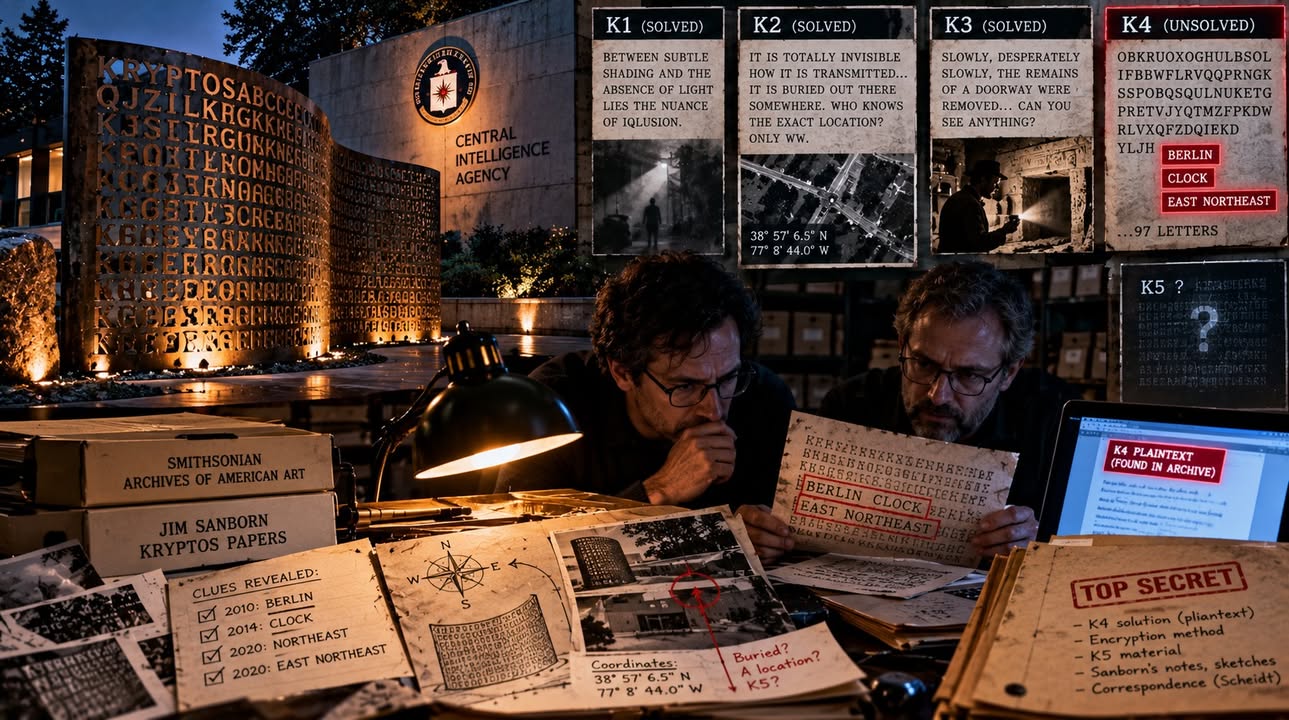
Two writers were digging through old papers at the Smithsonian when they came across something that had stumped some of the world’s best codebreakers for 35 years. It was the secret message hidden inside Kryptos, a famous sculpture standing outside CIA headquarters in Virginia. Since 1990, professional cryptographers, intelligence officers and thousands of amateur puzzle solvers had tried to decipher its final encrypted passage.
The two writers had taken a different approach. Instead of spending years working through the code, they found pieces of the answer among the artist’s old documents. And the man who created Kryptos was about to receive a very surprising email.
A Sculpture Built for Spies
In 1990, artist Jim Sanborn installed an unusual sculpture in the courtyard of CIA headquarters in Langley, Virginia. Called Kryptos, it featured a large, curved copper screen covered in 1,735 letters. At first glance, the arrangement looked like an enormous sheet of coded writing.
Sanborn had worked with retired CIA cryptographer Edward Scheidt to create four encrypted passages hidden within the sculpture. The first three were eventually deciphered.
One passage described revealing hidden information. Another contained geographic coordinates, while a third drew from the account of archaeologist Howard Carter entering Tutankhamun’s tomb.
But the fourth passage, known as K4, resisted every attempt to solve it. It contained just 97 letters, giving codebreakers fewer patterns to work with than a longer message might provide.
Over the years, people tried mathematical techniques, computer programs and increasingly powerful technology to uncover the words. Some spent decades working on it.
Sanborn occasionally released clues, including BERLIN, CLOCK and EAST NORTHEAST. Still, nobody publicly demonstrated a complete solution.
Two Writers Took a Different Approach
In 2025, novelist Jarett Kobek became interested in the sculpture and learned that some of Sanborn’s papers were stored at the Smithsonian’s Archives of American Art. He enlisted his friend Richard Byrne, a writer and journalist, to examine the collection.
On September 2, Byrne visited the archive and photographed documents connected to Sanborn’s work. The material included notes, sketches and papers from the artist’s development of Kryptos. Kobek began studying the photographs afterward.
Among the documents were fragments of text that caught his attention. Some contained words matching clues Sanborn had publicly released years earlier.
That raised an exciting possibility. Instead of another clue about how the encryption worked, Kobek appeared to be looking at pieces of the message itself.
The Answer Was Sitting in a Box
Sanborn had used strips of paper while creating the sculpture. Some contained portions of the original message, arranged and rearranged during the design process.
Those pieces had eventually ended up among his donated papers. Kobek and Byrne began putting the fragments together. Using the known clues as reference points, they reconstructed what appeared to be the complete 97-character passage.
On September 3, 2025, they emailed their findings to Sanborn. The artist had received countless proposed solutions over the years. Most were wrong, and he had become accustomed to people claiming they had finally solved his creation. This time was different.
Sanborn confirmed that the writers had recovered the correct message. Their discovery was extraordinary because they had reached the answer without figuring out how to decipher the original letters.
Sanborn Had an Unpleasant Surprise
The timing could hardly have been worse for the artist. Sanborn was preparing to auction his private Kryptos archive, including the original solution and instructions for deciphering the final passage. He was approaching his 80th birthday and wanted someone else to take responsibility for the puzzle that had occupied so much of his life.
The Smithsonian discovery caught him completely off guard. He had included the revealing documents when organizing his papers years earlier, apparently without realizing that someone might eventually use them to reconstruct K4. Sanborn asked that the relevant material be restricted, and access was closed for 50 years.
Kobek and Byrne chose not to publish the message, leaving other codebreakers free to continue working toward a solution.
Someone Paid Nearly a Million Dollars
Despite the unexpected discovery, Sanborn’s auction went ahead. On November 20, 2025, his private Kryptos collection sold for $962,500, including the buyer’s premium. The collection contained the original K4 message, the system used to encrypt it, working charts and other documents connected to the sculpture.
It also included information about another hidden layer of the project. At first, the buyer’s identity remained private. In June 2026, cryptocurrency investment firm Paradigm announced that it had purchased the archive.
The company had an unusual plan. Rather than reveal the message, it wanted to create a way for puzzle solvers to check their answers.
A Computer That Knows the Secret
According to Paradigm, its team arranged for Sanborn to enter the correct K4 message into a dedicated computer. The software generated a secure digital reference that could be used to check future submissions.
The company says the readable copy was then erased from the machine, allowing its team to operate the verification system without learning the words themselves. Puzzle solvers can submit their proposed answers and find out whether they match Sanborn’s original text.
There’s a small fee for each submission to discourage people from flooding the system with random guesses. The arrangement allows someone to demonstrate a successful solution without having access to Sanborn’s private documents. For enthusiasts who have spent years studying Kryptos, the challenge remains open.
There Was Another Secret
The auction also brought attention to something Sanborn had kept largely private for decades. Another encrypted passage existed, now known as K5.
The additional material dated back to Sanborn’s early work on Kryptos and suggested that the famous fourth passage wasn’t necessarily the end of the puzzle. Paradigm acquired the unpublished material along with the rest of the archive and announced plans to release it in the future.
That revelation gave codebreakers something new to anticipate. After spending decades struggling with K4, they learned that Sanborn had another challenge waiting behind it. And the artist had managed to keep that part of his work hidden for even longer.
One More Puzzle Waiting
Paradigm’s plans for K5 could eventually give puzzle solvers an entirely new set of letters to work on. Sanborn created the additional material in 1988, years before Kryptos was installed at CIA headquarters.
For decades, it remained among his private documents while the public concentrated on the sculpture’s four visible passages. Now the new owners have the information needed to introduce another challenge.
Codebreakers have spent 35 years trying to get inside Jim Sanborn’s head.
It turns out he had another room they didn’t know about.