Unexplained Stories
The Cold War Ended. Secret Radio Stations Are Still Talking
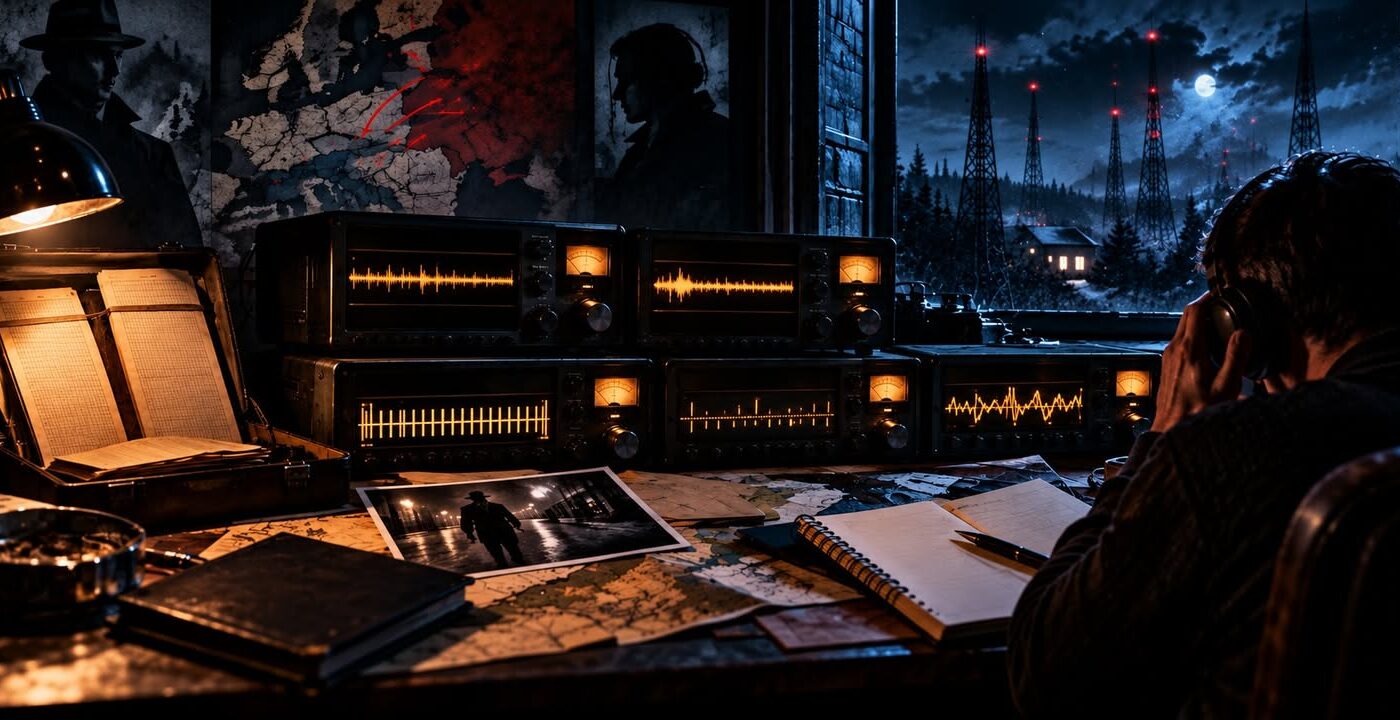
A woman’s voice cuts through the static on a shortwave radio. She announces a three-digit number, says the word “Oblique” and starts reading a long string of numbers. There’s no introduction, no explanation and no clue who she’s talking to.
When she’s finished, she says “Out.” The frequency goes quiet until the next broadcast.
This isn’t some old Cold War recording. People were still hearing these transmissions in 2026.
The Voices That Never Went Away
During the Cold War, intelligence agencies used secret radio broadcasts to send messages to agents working in other countries. These became known as numbers stations because of the strange voices reading seemingly endless strings of numbers.
Some used women’s voices, others men’s. A few played music before the messages began, while others started counting without warning. Anyone with the right kind of radio could listen, but only someone with the proper code could understand what was being said.
Many stations disappeared after the Soviet Union collapsed in 1991. Others kept going, sometimes changing their frequencies, voices or broadcast schedules.
One of them is E07, nicknamed the English Man. According to radio-monitoring group Priyom, it’s a Russian station that uses a male English voice to deliver coded messages.
A typical broadcast starts with a three-digit identifier repeated several times. If there’s a message, the voice announces how many groups of numbers will follow before reading them out.
The station sometimes repeats the same message on different frequencies about 20 minutes apart. That gives whoever is listening another chance to catch it if the first signal is difficult to hear.
The Woman Called Oblique
Another station, E11, is known for its distinctive female voice. Its broadcasts are associated with Poland, and it follows a regular schedule, changing frequencies depending on the month.
Sometimes the voice announces an identifier and ends the transmission without delivering a message. Other times, she reads 30 or more groups of five-digit numbers, speaking slowly enough for someone to write them down.
Radio enthusiasts have been following E11 for years. They’ve recorded its messages, tracked its frequencies and worked out when to expect the next broadcast.
Priyom’s records show that the station was still operating in October 2026. Nobody outside the operation knows who the individual messages are meant for. The intended listener could be sitting in an apartment, a hotel room or somewhere far from home, quietly receiving instructions from a voice coming over the radio.
How Nobody Else Can Read the Messages
Here’s the clever thing about numbers stations. There’s no need to hide the broadcast itself.
Shortwave signals can travel thousands of miles, reaching listeners across entire countries and sometimes continents. Anyone can record the numbers and share them online. Without the right information to decode them, though, the message remains a mystery.
One method used for secret communications is called a one-time pad. The sender and receiver have matching sets of random numbers that allow them to turn a readable message into a jumble of digits and back again.
Each set of numbers is supposed to be used only once. When done correctly, the method is extraordinarily difficult to crack, even if someone records every second of the transmission.
And there’s another useful trick. The person receiving the message never needs to answer, so they don’t have to transmit a signal that might give away their location. It’s an old-fashioned system, but it still has some remarkable advantages.
Two Voices Suddenly Went Silent
For years, radio enthusiasts listened to two stations associated with a Ukrainian operator. One was S06s, nicknamed the Russian Lady, which delivered coded messages in Russian. The other, E17z, used an English female voice.
Both followed regular schedules, and listeners had become familiar with their broadcasts. But in February 2022, something changed.
Monitoring records show their final known transmissions appearing shortly before Russia launched its full-scale invasion of Ukraine on February 24. The last known S06s broadcasts took place around February 21 and 22, while E17z’s final recorded message was heard on February 17.
After the invasion began, the operator went silent. Nobody publicly explained what had happened. The equipment might have been abandoned, the broadcasts could have moved elsewhere, or the people behind them might have switched to another way of communicating.
Whatever the reason, a radio network that had operated for decades disappeared just as a major war began.
Russia’s Famous Buzzer
Not every mysterious radio station has a voice reading numbers. Tune a shortwave radio to 4625 kHz, and you may hear a repetitive electronic buzzing sound. It’s been coming from a Russian station known as The Buzzer for decades, and it normally runs day and night.
Every so often, the buzzing stops and a Russian voice breaks in. The speaker reads a message containing identifying codes, unusual words and groups of numbers. When the message is finished, the buzzing starts again.
The station became famous under the nickname UVB-76, although that name came from a mistaken interpretation of an earlier Russian callsign. Its more recent collective callsign is NZhTI.
Priyom identifies The Buzzer as part of an active Russian military communications network. Its history goes back to the 1970s, and the people monitoring it have heard plenty of peculiar things over the years.
Sometimes there are unexpected voices or strange interruptions. Listeners have even picked up what sounded like conversations happening in the background, apparently never intended to go out over the air.
Russia has other military radio networks with equally odd sounds. One, called The Pip, makes a regular piping noise. Another, The Squeaky Wheel, produces exactly the kind of squeaking sound its nickname suggests.
They’ve become familiar companions to radio enthusiasts who spend their evenings searching the shortwave bands for unusual activity.
A Message From October 14
Dedicated listeners are still tracking numbers stations, keeping records of their broadcasts and noting anything unusual. Some have collected years of recordings, allowing them to spot changes in schedules, voices and transmission patterns. One recent entry comes from October 14, 2026.
According to Priyom’s monitoring records, E11 Oblique broadcast a message containing 32 groups of five-digit numbers. The station used the identifier 718, and the message began with 28094.
Someone listening that day could have written down the entire sequence. In fact, the numbers were recorded in a public monitoring log, where anyone interested can examine them.
The final group was 55842.
Somewhere, someone might already have known exactly what to do with it.