Unexplained Stories
Sixty-Two Children Watched Something Land Beside Their School in Zimbabwe
Zimbabwe was already watching the sky that week. On the Wednesday night, a fireball had crossed the whole of southern Africa, breaking up in burning streaks, and ZBC Radio had spent the evening taking calls from people who had seen it.
What happened on the Friday was smaller, closer, and seen only by children.
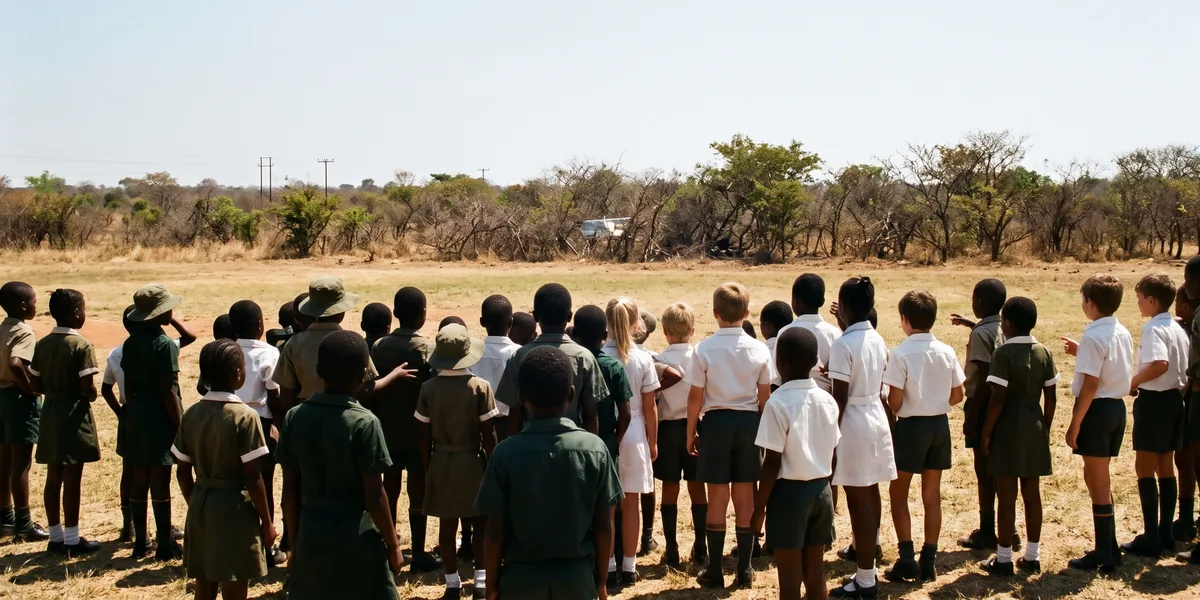
Ariel School was a small, expensive private school in farming country, 22 kilometres southeast of Harare. Its pupils came from wealthy families, black and white and Indian, most of them Zimbabwean-born.
At ten o’clock the children were out for the mid-morning break, spread across the playing field in the heat. The teachers were all inside at a staff meeting. The only adult anywhere near the playground was the woman who ran the tuckshop.
Beyond the field lay a strip of rough ground the children were not allowed into — long grass, thorn scrub and small trees, thick enough to hide a child. That is where the children said the objects came down.
Three or four of them, silver and bright, flashing in the sky before they dropped along the line of the power poles toward the bush. There was a whirring noise. The light coming off them was white and silverish, so bright that some of the children could not make out a shape at all.
Then something got out.
The figure the children described to investigator Cynthia Hind was about a metre tall, dressed in a shiny black one-piece suit like a wetsuit. It had long black hair and a large head.
Guy, an eleven-year-old Hind named in her report, said the eyes sat lower on the cheek than ours, large and elongated. The mouth, he said, was just a slit.
Between one and four of the figures came out of the craft and moved toward the children.
Some of the children ran. The older ones mostly stayed where they were and watched the figures come closer. Among the black children, some took the small men in black for tikoloshes, the goblin figures of Shona and Ndebele stories, and burst into tears, certain they were about to be eaten.
Guy told Hind he had been excited at first. “I was excited at first but then I saw one of the smaller boys crying and when I asked him why, he said he was afraid. Then I also became afraid.”
The whole thing lasted about fifteen minutes. Then the objects were gone, and 62 children were left standing in the heat with the same story.
Back in class, the teachers did not believe them. The children went home and told their parents, and the next day the parents came to the school in numbers, wanting to know what had happened out at the edge of the field.
The story went out on ZBC Radio.
The BBC Came on Monday
On the Monday, Tim Leach, the BBC’s correspondent in Zimbabwe, arrived with a camera and filmed the children telling it. Leach had covered wars. What he said about that schoolyard followed him for years: “I could handle war zones, but I could not handle this.”
On the Tuesday, Cynthia Hind came. Hind edited a small journal called UFO Afrinews and was the most dogged UFO investigator on the continent, and she had already spent that week logging fireball reports from half of southern Africa.
She interviewed the children and set them to drawing what they had seen. A colleague, Gunter Hofer, walked the rough ground with a Geiger counter, a metal detector and a magnetometer. The instruments found nothing — no marks, no readings, nothing to take away in a bag.
The drawings were harder to walk away from. More than thirty children, aged six to twelve, from every background in the school, drew the same arrangement: a disc in the bush, and beside it a small figure with a big head and enormous eyes.
Not identical drawings — children’s drawings never are.
Hind kept 22 of the clearest. The children had not agreed on what the figures were. Aliens to some, tikoloshes to others, just little men to others — but the thing they described was the same.
The Professor From Harvard
In November, Dr. John Mack flew in. Mack was a professor of psychiatry at Harvard Medical School and a Pulitzer Prize winner, and that spring Harvard had set up a committee to investigate his work on people who said they had been taken by aliens.
He spent two days at the school with a camera, interviewing the children one at a time. He was not looking for a saucer. He was looking for the thing psychiatrists look for: whether the children were performing, or disturbed, or repeating something an adult had fed them.
He came away saying they were none of those things. The children, he concluded, were describing something that had happened to them.
It was in Mack’s interviews, and only there, that the story grew its strangest part.
Some of the children told him the figures had spoken to them without speaking — thoughts arriving whole, behind the eyes. A fifth-grader said he had been warned “about something that’s going to happen,” and that “pollution mustn’t be.” An eleven-year-old girl put it in words that have been quoted ever since: “I think they want people to know that we’re actually making harm on this world and we mustn’t get too technologed.”
None of that appears in Hind’s September record, and it is worth saying so plainly. Her children talked about a craft, a figure, and being frightened; the warning about the Earth surfaced two months later, in Mack’s interviews.
Mack persuaded the parents and teachers of one thing before he left: accusing the children of lying would do real harm. Whatever had happened out by the bush, the children believed it had happened.
The Explanations Came Later
The explanations have been arriving ever since, each one tidier than the last. The fireball two nights before was real enough — a Russian rocket stage burning up — and it explained the Wednesday sky handsomely. It said nothing about a Friday morning, in broad daylight, at the edge of a school field, for fifteen minutes.
The children had panicked together, the way schoolchildren sometimes do, said a paper in a medical journal. Or they had seen a dust devil spin through the bush. Or — the newest entry, proposed in 2024 — they had mistaken a travelling puppet show, touring to teach children about AIDS, for visitors from the sky.
And in 2023, one of the 62 went on Netflix and said the whole thing began with him. Dallyn Vico said he and a friend had pointed at a shiny rock, called it a spaceship to get out of class, and watched the lie take the school.
His difficulty is that he is on film twice. In 2008, fifteen years before the confession, the same man told a documentary camera that something definite — “definite, definite, definite” — had happened that morning, and described a light flashing colours in the sky.
Sixty-two children is a lot of liars to recruit before lunch.
What Became of Them
The children are in their late thirties now, scattered the way Zimbabweans scattered. Salma Siddick became a human rights lawyer, and on camera she was blunt: “I stand by what I saw.” “There was no reason for any of us to make that up.”
Emily Trim was eight that morning, playing on the logs at the edge of the grounds with her friend when she heard a high pitch and saw a flash. As an adult she said two beings had moved beside them without touching the ground, almost mimicking them, before they were suddenly at arm’s reach and the images started coming through their eyes. She spent the rest of her life painting what she said the beings had shown her — she called the paintings manifestations of the messages — and she never took back a word of it before her death in 2024.
In Harare in 2014, a reporter found another of the children, Sarah, drinking in a downtown bar — the only one of them still in the country, she thought. She said she can still sense when they are back in the atmosphere. “It happened, OK,” she said.
The rough ground beyond the field is gone now, stumped and mown into a second sports field. The school is bigger than it was and doing well, and that part of its history has mostly left the staffroom.
The drawings stayed.
Hind died in 2000 and Mack in 2004, and the case they built now rests where it always rested: on 62 children who drew the same thing and described the same morning. Cases built on child witnesses are supposed to dissolve as the witnesses grow up, get embarrassed, and quietly drop the story.
This one did the opposite.
Thirty years on, the ones who can be found still tell it the way they drew it. And nobody, in three decades of trying, has produced the thing that was actually in the bush.