Unexplained Stories
Two Thousand People Watched Rockets Cross Sweden. The Military Searched the Lakes and Found Nothing
In the summer of 1946, Sweden had been out of the war for a year. The country had stayed neutral, its lakes and forests were quiet, and its people were getting back to regular life.
Then things started crossing the sky in broad daylight, and they were shaped like rockets. The first reports came from Finland on February 26. By May they were coming in from all over Sweden, and they did not stop until December.
Nobody who saw one described a light or a glow. They described a machine.
What People Saw
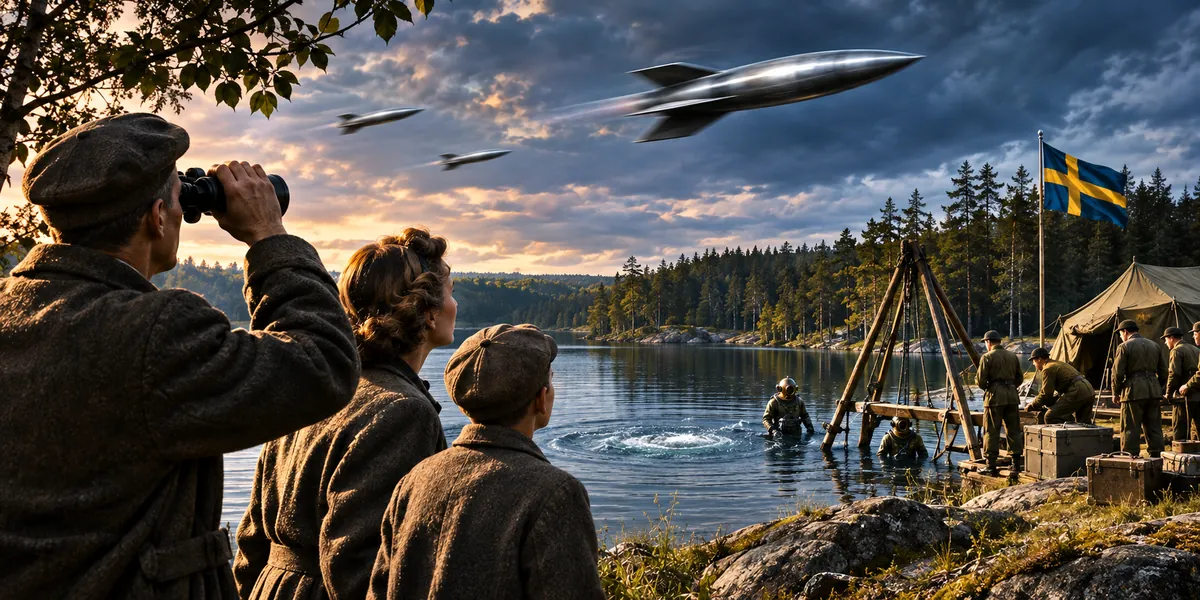
The objects were rocket-shaped or missile-shaped, grey, sometimes with wings and sometimes without. Most were seen for only a few seconds. They flew low, and they flew level. Some moved at the speed of an airplane, some crossed the sky much faster, and some travelled in formation.
What they did not do is just as clear in the reports. They left no exhaust trail behind them. They made no sound. Witnesses standing right under them heard nothing at all.
And they came down in lakes. Again and again, all summer, people watched these things dive into Swedish lakes and vanish under the water. A few reports went stranger than that. People watched objects hit the water, run across the surface of a lake under their own power, and only then sink out of sight. Whatever these things were, hitting a lake did not finish them.
The Swedish Army took the reports seriously enough to issue an order about them. Newspapers were told not to print the exact location.
The Numbers
By the time the wave ended, about two thousand sightings had been logged across Scandinavia. Close to a thousand of them reached the Swedish authorities. On July 9 and 10, more than 250 reports came in. On August 11 alone, more than 300 people reported seeing one.
Two hundred of the sightings were backed up by radar. Whatever people were looking at, the instruments were seeing it too. The Defence Staff set up a committee to investigate, chaired by Colonel Bengt Jacobsson of the air force. A first group that looked at the reports in early July came back with a strange verdict for 1946: this did not fit a rocket. It looked more like a jet-driven craft with wings.
The committee's own records show the kind of detail that does not come from imagination. On July 22, a coast-defence radar tracked one of the objects at about 400 metres a second, and a coastal-artillery rangefinder at Mällsten confirmed the track.
On August 14, the crew of a B 18A bomber chased one. They described a body with no wings and no rudder, and it outran them.
The Day Four Lakes Were Hit
July 19 was the day the wave stopped being something in the sky and became something in the water. That day, people saw objects coming down in four lakes in northern Sweden: Kattisträsket, Kölmjärv, Marmen and Vasarajärvi.
Kölmjärv is the one the military went into properly. Witnesses there watched a grey, rocket-shaped object with wings crash into the lake, and one of them, Knut Lindbäck, went to the police. Another witness heard a thunderclap, as if the thing had blown up as it hit.
The next morning, a lieutenant from the Boden engineer corps named Karl-Gösta Bartoll arrived with four men. They sealed the lake off and went to work. The search went on for three weeks. Divers and soldiers worked the bottom of that lake the way you would flip a room that you know contains hidden gold.
They found the bottom torn up, with a crater in it about thirty metres across. They took some three and a half thousand samples from the lake bed. They found no rocket. They found no wreckage of any kind, not a panel, not a motor, not a scrap of casing.
Bartoll wrote up his report when it was over. His conclusion was that there were many indications the Kölmjärv object had destroyed itself, and that it was probably made of a lightweight material, possibly a kind of magnesium alloy.
Something heavy enough to tear a thirty-metre hole in the bottom of a lake had gone in, and then, on the evidence of the men who searched for it, it had come apart into nothing they could hold.
It Was Not the Russians
The obvious answer in 1946 was the Russians. The Germans had built their rockets at Peenemünde on the Baltic coast, the Soviets had taken the place over, and Sweden sits right across that water. It was the first theory everybody reached for. It was rejected, and not by naysayers — but by Swedish, British and American military investigators.
Their problem was simple. In seven months of sightings, crashes and searches, nobody ever found one recognizable piece of a rocket. Rockets leave wreckage. Two thousand sightings left none.
The behaviour was wrong too. A V-2 does not fly level at airplane speed, travel in formation, manoeuvre, or cross a sky in silence with no exhaust behind it. The investigators had the reports in front of them, and the reports did not match the missile theory in any way.
The committee worked on the problem until December 12, 1946. It explained a bunch of the reports as meteors and fireballs. No weather balloon explanation for once at least! But there was still a massive glaring problem.
Meteors do not fly low and level, do not get chased by bombers, and do not show up on coast-defence radar doing 400 metres a second.
The committee closed without a conclusion.
The File That Reached Truman
The Americans were watching all of this from the start. On August 22, 1946, a memorandum on the ghost rockets over Scandinavia landed on President Truman's desk, from the Director of Central Intelligence.
Jimmy Doolittle came to Sweden that summer and was briefed on the case. He was told, among other things, that the objects had been tracked on radar several times. In January 1947, a US General Staff intelligence review summed the whole thing up. Swedish officials, it said, privately blamed Soviet tests of captured German weapons.
The review's proof for the evidence was inconclusive. No object had been recovered, by anybody, anywhere.
Greece Ran Into the Same Thing
Sweden was not the only country dealing with it that autumn. On September 1, 1946, projectiles were seen over Macedonia and Thessaloniki in Greece, and the Greek Prime Minister, Konstantinos Tsaldaris, confirmed the sightings in public four days later.
By the middle of September they had also been seen over Portugal, Belgium and northern Italy. Greece did what Sweden did and opened its own investigation. The man they put in charge of it was not a nobody: Paul Santorini was one of the country's leading physicists, a developer of the proximity fuze used on the first atomic bomb, and a holder of patents on radar and missile guidance systems. The Army gave him a team of engineers and pointed him at the sky.
Santorini kept quiet about what his team found for twenty years. In 1967 he finally said it out loud, in a lecture to the Greek Astronomical Society that was broadcast on Athens Radio. "We soon established that they were not missiles," he said. "But, before we could do any more, the Army, after meeting with foreign officials, ordered the investigation stopped. Foreign scientists flew to Greece for secret talks with me."
He told researchers afterwards why the lid had been put on it. The officials involved were afraid to admit, in public, that a superior technology existed — one against which there was no defence.
What Is Left of It
The reports faded out by December 1946, almost as suddenly as they had started the February before. No second summer ever came. Sweden kept everything. The Defence Staff's ghost rocket file still exists, four volumes of reports, summaries and committee minutes, sitting in the national archives in Stockholm, where anyone can read them now. It sits under a plain file title that translates as "documents concerning space projectiles."