Unexplained Stories
A Seamless Metal Sphere Came Down Over Buga. X-Rays Showed Smaller Spheres Inside It
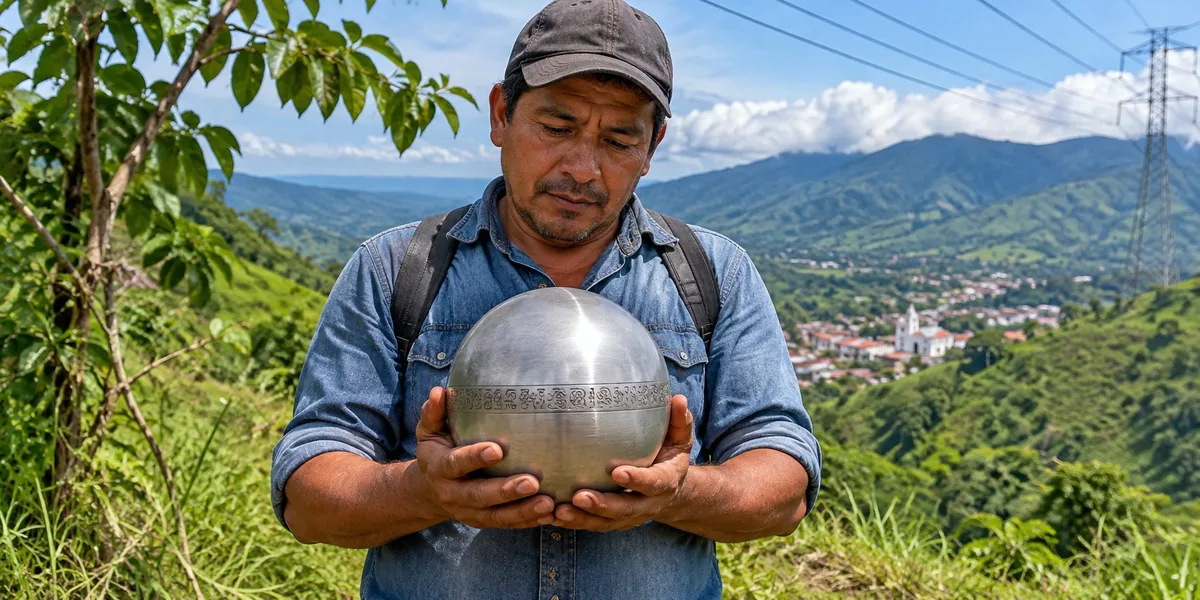
On the afternoon of Sunday, March 2, 2025, José Arias Restrepo was walking the slopes of Alto Bonito, on the outskirts of Guadalajara de Buga, Colombia, doing what he often did between selling peanuts: sweeping the ground with a metal detector, hunting for old coins. Something the size of a soccer ball whizzed past his head.
Arias thought it was a bird at first. It clipped a high-tension power line and crashed on the hillside in front of him. His friend María had her phone out. She filmed the bright sphere over the valley: hanging, sliding sideways, dropping in a zigzag that did not look like falling. The footage is about eight minutes long. Within two weeks it was everywhere.
Arias walked over, picked the thing up with his bare hands, and took it home.
A Ball With No Way In
There was no seam on it. No weld. No joint, no screw, no hatch, no opening of any kind. None of the marks that almost every metal object has somewhere.
The middle had a band of small engraved characters, about seventeen of them, like letters from an alphabet nobody in Buga could read. Arias says the ball made him sick. He described dizziness, vomiting, headaches, a metallic taste that stayed in his mouth, and a stretch of days where his fingerprints faded so far that his phone stopped recognising his thumb.
The sphere did not go to the police. It did not go to a university, or a government office, or a museum.
It went to his cousin.
Two Months in a Metal-Detector Shop
Two or three days after the recovery, Arias handed the sphere to David Vélez, his first cousin. A shareholder in Germany Company, a Cali firm that sells metal detectors to treasure hunters, and the administrator of a Latin American UFO-hunters group online.
Vélez kept it at the company for about two months. He said it sat on a kind of pedestal. He detected electromagnetic fields coming off it. The most repeated claim in the entire case was that it grew heavier the longer he had it, starting around 2kg and getting up to around 10kg.
Vélez also told El País de Cali that an unnamed laboratory in Bogotá called him and claimed the sphere was part of an experimental program started in 2011, and asked for it back. He refused. He has never named the laboratory.
In April 2025 the whole thing changed hands, and it changed size. Jaime Maussan, the Mexican journalist who has been the Spanish-speaking world's best-known UFO promoter for forty years, presented the sphere in Mexico City on April 18. The ball crossed the border without a single customs problem. Colombian analysts still bring that up, because objects being promoted as possible alien relics do not usually travel like carry-on luggage. It ended up in a safe at Maussan's offices in Santa Fe.
On June 20 he held a press conference around it. Three hours long. Arias was there. Steven Greer was there. And so was Eric Burlison, an actual sitting U.S. congressman from Missouri who serves on the House's UAP subcommittee.
Look at that run for a second. In under four months the ball went from a hillside in Valle del Cauca to a stage in front of a congressman. And in all that time, it never once passed through the hands of a scientist who did not already believe in it.
What the X-Rays Showed
The first person to look inside the ball with real equipment was José Luis Velázquez, a radiologist in Cali. He X-rayed it, and what he said made the case famous. "It is a very rare piece," Velázquez told People magazine. "I had never seen a piece like this."
His scans showed a wall made of three layers of metal, one right up against the next, no gap between them. And inside the ball, sitting in the dark of it, were smaller spheres. Nine of them in his first images.
Later scans run by Maussan's team, at higher exposures and from more angles, pushed the number up. Sixteen. Sometimes eighteen. Small spheres arranged around a dense core in the middle, joined to it by fine connections, like spokes running into the hub of a wheel.
So is it nine or eighteen? It depends which scan you read. Both numbers are on the record. And nobody outside the team has ever been given the raw images to settle it.
The claims kept coming through 2025, one podium at a time. The metal was an aluminium alloy with zinc, copper, iron, magnesium, manganese and nickel in it. Inside the ball ran fifty-two optical fibres, fine as hairs. Identified, the team said, by specialists linked to Mexico's National Autonomous University, UNAM. In October, Greer announced a carbon-14 result. Resin taken from small holes around the sphere's equator had been dated to 12,560 years old. The work was attributed to the Center for Applied Isotope Studies at the University of Georgia.
Now ask one simple question about that whole list. Whose name is actually signed to any of it? UNAM has published no report. The University of Georgia has put out no finding of its own. And carbon-14 has a limit nobody at the podiums mentioned: it dates organic material. It can tell you the age of a smear of resin. It cannot tell you when a metal ball was made. On top of that, the sample came off an object that had been handled for two months in a metal-detector shop, so contamination cannot be ruled out either. Every technical claim in this case leads back to the same small circle of custodians and promoters. The X-rays are real images of something. What they are images of has only ever been interpreted by the people who own the ball.
The Scientists Who Said No
Colombia's own scientists were not quiet about it, and they were not impressed. Santiago Vargas, an astrophysicist at the National University of Colombia's Astronomical Observatory, pointed out that everything identified inside the sphere (aluminium alloy, copper contacts, optical fibre) is completely terrestrial. His call: most likely a modern technological artifact, and the prehistoric story built around it has no scientific credibility.
Marino Guarín, who runs the Cali Astronomy School, called the whole affair charlatanism done for publicity. And he asked the question that hangs over this case. Where is the university's official report? If the sphere had real substance, he said, the news would travel through scientific journals. It travelled through TikTok.
Lauren Flor Torres, an astrophysicist at the University of Antioquia, made the quietest point of all, and it might be the most damaging one. Anything that falls to Earth from space arrives marked by the fall. Meteorites carry crusts changed by the friction of the atmosphere. The Buga sphere is pristine. No scorching. No ablation. Whatever trip it took, it does not look like it took that one.
Even people friendly to the wider mystery kept their distance. Garry Nolan, the Stanford professor who has spent years arguing that anomalous materials deserve serious laboratory study, put the Buga sphere at "99% a terrestrial artifact." Physicist Julia Mossbridge looked at it and saw "a really cool art project." And seamlessness, the detail that started all of this, turns out to be the weakest card in the hand. Engineers will tell you industry makes seamless spherical vessels every day. Spin-forming and internal friction welding turn out pressure tanks and propellant spheres with no seam on the outside for anyone to find. A ball with no way in feels strange to hold. It is not impossible to make.
There is a precedent, and it is almost fifty years old. In 1974 the Betz family found a seamless metal sphere on their land in Florida. It hummed. It seemed to move on its own. It made national news. The U.S. Navy X-rayed it and identified it in one sentence: a huge ball bearing, a check valve out of a chemical plant's piping.
The Betz sphere got its Navy. The Buga sphere has never been handed to anyone with no stake in the answer.
Still in the Safe
In November 2025 the community council of Alto Bonito unveiled a monument at the spot where the sphere came down. Maussan came for it. The hillside where a peanut vendor bent down and picked up a metal ball is now a place people travel to see.
The ball itself sits in a safe in Mexico City. Here is the frustrating part. Everything about it that could be settled could be settled in a week. One accredited laboratory. One blind analysis. Samples taken by people with no channel to promote and no monument to unveil. Results published with names and institutions attached. That week has been sitting there available since March 2025. Nobody has ever scheduled it.
And more video keeps arriving. A second sphere was filmed over Yumbo, three months after the first. Analysts have already picked its flight path apart frame by frame and found the jumps of a composite. The sky over Valle del Cauca is not done producing spheres.
Neither, so far, is anyone done declining to test the one that can actually be held.