Unexplained Stories
Something in Sumatra Keeps Leaving Footprints Nobody Can Explain
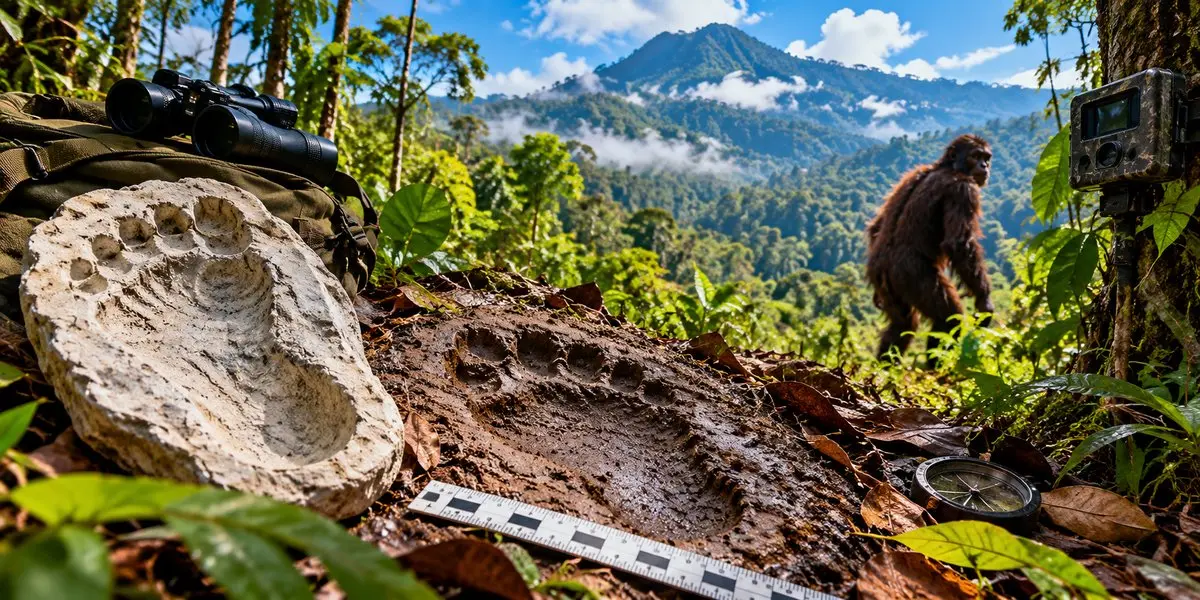
A cast taken in Sumatra in 1999 has kept one of the world’s strangest primate searches alive for more than a quarter century.
Expedition leader Adam Davies preserved a track found near Gunung Tujuh that did not fit comfortably with the footprints of familiar local animals. Cambridge primatologist David Chivers later compared the cast with known primates and regarded it as evidence pointing toward an unknown ape, while anthropologist Jeffrey Meldrum agreed it looked primate-like but raised another possibility: the impression might have been made by a hand rather than a foot.
The Footprint Was Not the Beginning
Long before that cast was made, people around Sumatra’s Kerinci region had been describing a short, powerful, hairy animal that walked upright and spent much of its time on the ground.
The name Orang Pendek means “short person,” and the modern search became closely associated with British journalist Debbie Martyr and wildlife photographer Jeremy Holden. Martyr arrived in Sumatra in 1989 and began collecting reports after hearing local accounts of the creature.
What started as curiosity became years of fieldwork. Martyr and Holden worked around Kerinci Seblat National Park, using interviews and camera traps while also contributing to wildlife research in one of Sumatra’s richest forest systems.
PBS later profiled Holden’s work, noting that the same camera-trapping effort documented rare wildlife, including species that had never before been photographed. The cameras proved they could find elusive animals. They just never delivered the clear Orang Pendek image researchers wanted.
Both Martyr and Holden also reported seeing an upright animal they believed matched the local descriptions. Those sightings remained eyewitness accounts, but they gave the search an unusual persistence because the people pursuing the mystery were spending years in the same forests rather than arriving for a brief expedition.
The 1999 Cast Gave Researchers Something to Measure
Davies’s footprint cast changed the conversation because it could be examined after the expedition ended. Chivers compared its structure with known primates and described a combination of features unlike the examples available to him. Meldrum also considered the impression primate-like, although his suggestion that it could be a hand showed how difficult it was to turn one track into a biological identity.
That uncertainty did not make the cast useless. A physical impression can be measured, photographed and compared repeatedly in a way a fleeting sighting cannot. It also created a problem that has followed Orang Pendek ever since: the evidence often seems unusual enough to deserve another expedition without becoming complete enough to establish a species.
Hair samples produced the same kind of frustration. Some investigators reported morphological results they believed differed from known primates, while later genetic work on hairs attributed to mystery primates did not reveal a new Orang Pendek lineage. A 2014 DNA study that tested samples linked to several alleged anomalous primates found known animals or humans among nearly all of the successfully identified material.
Another Expedition Found a Hand-Shaped Impression
In 2011, a large expedition returned to the Kerinci area with teams, cameras and casting material. Near a damaged rotting log, searchers found an impression that Richard Freeman described after cleaning as a handprint rather than a footprint. He noted a rounded palm, short thumb and thick fingers that looked unlike the long, narrow hand of a Sumatran orangutan.
Hair was collected nearby, and camera traps were deployed again. The expedition returned with casts, samples and thousands of camera images to examine, but no unmistakable photograph of an unknown upright ape emerged. The search had once again produced material interesting enough to study without producing the one image that could instantly change the status of the creature.
That pattern is especially striking in Kerinci Seblat because camera trapping has been so productive for known wildlife. Holden’s work helped document rare animals in a forest where even large mammals can pass unseen for long periods. Every successful photograph of an elusive tiger, tapir or rare rabbit made the missing Orang Pendek image feel more conspicuous.
Sumatra Has Already Hidden One Great-Ape Surprise
The island itself gives researchers a reason not to dismiss surprises too quickly. In 2017, scientists formally described the Tapanuli orangutan as a distinct species after combining genetic, anatomical and field evidence. It was the first new living great-ape species described in decades.
That discovery did not validate Orang Pendek, and no physical evidence links the two animals. It did demonstrate that scientific understanding of Sumatra’s primates was still changing in the twenty-first century. A large primate could be known locally and yet remain misunderstood by science for a very long time before enough evidence accumulated to classify it properly.
Orang Pendek has never crossed that line. No accepted body, bone, clear photograph or diagnostic DNA sample has established the animal as a species. What remains instead is a trail of witness accounts, casts, debated hair samples and field researchers returning to the same mountains.
The Forest Keeps Giving Back Tracks Instead of an Animal
That is why the old casts are still important to the story. The 1999 impression can be pulled from a collection and examined again, just as later prints and hand-shaped marks can be compared with known animals. Each one preserves a moment when something pressed into the Sumatran ground and left researchers arguing about what made it.
The cameras have photographed almost everything around the mystery.
Orang Pendek keeps leaving the forest one footprint ahead.