Unexplained Stories
The Romanian Forest Where People Report Missing Time and Strange Lights
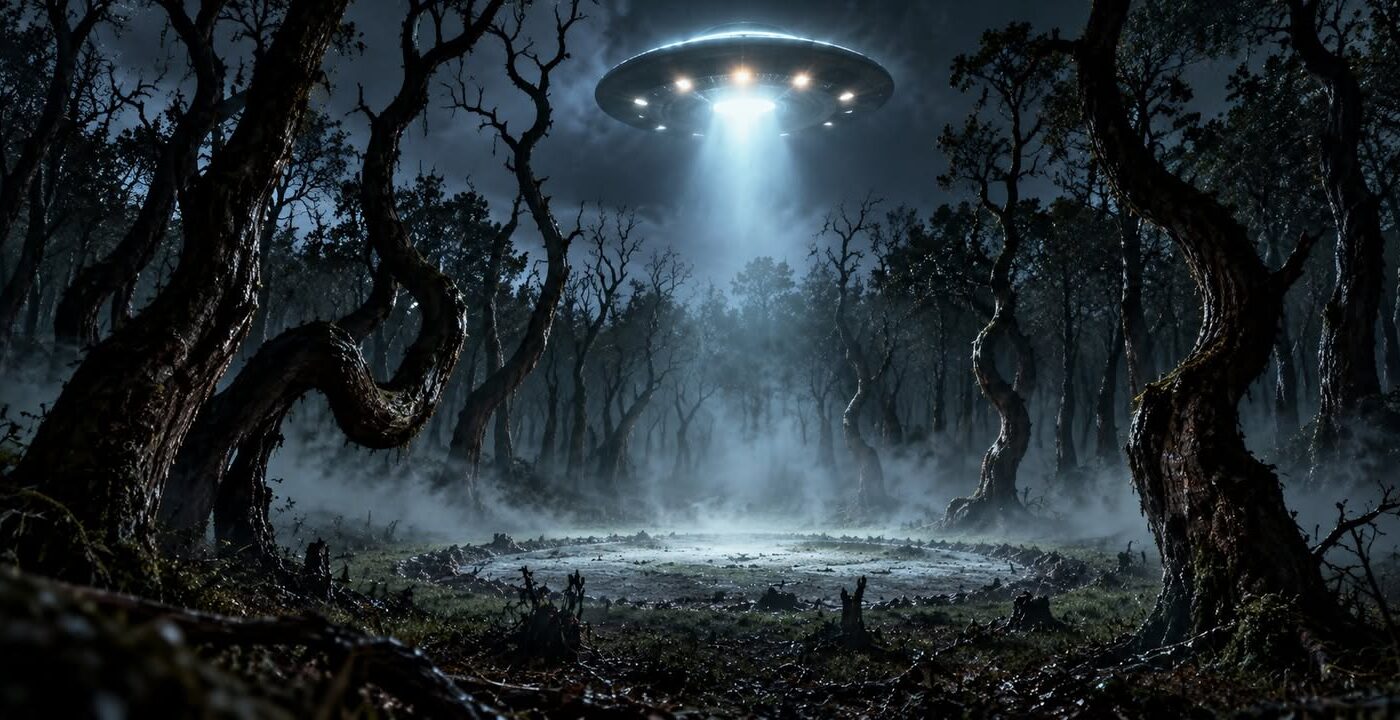
There is a forest in Romania where some trees grow in strange, twisted shapes, people claim to have lost hours of their lives, and a man once photographed something extraordinary hovering above the treetops. It’s called Hoia-Baciu, and it sits just outside Cluj-Napoca, in the heart of Transylvania.
You can walk into it on an ordinary afternoon. There are trails, birds, patches of sunlight and plenty of trees that look perfectly normal. But venture farther inside, and the scenery begins to change.
Some trunks bend sharply before turning upward again. Others twist into shapes that look almost deliberately sculpted.
And somewhere among them is a grassy clearing that has become one of the most talked-about locations in Romanian paranormal history. The stories surrounding this forest are much older than the tourists who now come looking for ghosts.
The Shepherd Who Never Came Home
According to local legend, a shepherd once entered Hoia-Baciu with a flock of sheep and disappeared. Neither the shepherd nor his animals were ever seen again.
Another story tells of a young girl who wandered into the woods and vanished. When she supposedly returned years later, she hadn’t aged as expected and had no idea how long she’d been gone.
These are stories passed down through generations, with no reliable dates or records attached. But they helped give Hoia-Baciu its peculiar reputation long before anyone arrived carrying cameras or ghost-hunting equipment.
The idea that someone could enter the forest and lose track of time became one of its most enduring legends. Even the trees helped create the atmosphere. In some areas, their trunks curve close to the ground before reaching skyward, producing a woodland that looks wonderfully odd in broad daylight.
And near the heart of the forest lies a feature that has attracted almost as much attention as the disappearances.
The Clearing Where the Trees Stop
Deep in Hoia-Baciu is a broad, roughly circular opening surrounded by woodland. It’s commonly called the Round Clearing, or Poiana Rotundă.
Large trees grow around its edges, but the open ground itself remains mostly grassy. From certain angles, it looks as though someone deliberately cleared a space in the forest and left the surrounding trees untouched.
Visitors have long associated the clearing with strange lights and unusual sensations. Some describe feeling watched, while others report sudden discomfort or an overwhelming urge to leave.
Researchers have examined the forest’s vegetation and physical environment over the years. But for people fascinated by its mysteries, the clearing has become something closer to a landmark: a particular spot where they hope to experience whatever has made Hoia-Baciu famous.
In the summer of 1968, an ordinary afternoon outing would give the forest an entirely new reason to be remembered.
A Sunday Picnic in August 1968
On August 18, 1968, Emil Barnea, a 45-year-old Romanian technician, visited the forest with three companions, including his girlfriend, Zamfira Mattea. It was a warm Sunday, and the group had gone into the woods to enjoy the afternoon.
Around lunchtime, Barnea was gathering sticks for a small fire when his companions suddenly called him back. They had spotted something in the sky.
According to accounts preserved by Romanian UFO investigators, Barnea looked above the trees and saw a large, silvery object moving slowly through the air. It was flattened and round, resembling a disc.
His camera was lying on a blanket nearby. Barnea hurried to retrieve it and began taking pictures as the object moved across the sky, reportedly growing brighter and changing its angle.
At one point, the witnesses described the object tilting dramatically, almost as though it were rolling through the air. Moments later, it accelerated upward and disappeared.
The entire encounter lasted only a few minutes. Barnea had managed to take several photographs, including images in which the unusual shape was clearly visible.
The Photographs Reached the Newspapers
Barnea didn’t immediately turn his experience into a public spectacle. Accounts of the incident say he was worried people would ridicule him, and some time passed before he showed the photographs to engineer and UFO investigator Florin Gheorghiță. Gheorghiță recognized the unusual nature of the pictures and began investigating.
On September 18, 1968, exactly one month after the sighting, Romanian newspapers reported the incident. The photographs attracted considerable coverage and eventually reached UFO researchers outside the country.
Romanian television also covered the case, bringing the pictures to a wider audience. What attracted attention was the sequence of images.
Barnea hadn’t captured a single mysterious spot in the sky. His photographs appeared to show a disc-like object in different positions as it moved away.
Investigators studied enlargements and examined the photographs for clues about the object’s shape and movement. The case was eventually discussed in international UFO publications. And Barnea wasn’t the only person who had been paying attention to unusual activity in those woods.
The Biologist Who Kept Returning
Romanian biologist Alexandru Sift had begun investigating unusual phenomena around Hoia-Baciu years before Barnea’s photographs appeared. Sift was interested in reports of strange lights, unexplained objects and unusual images captured on film. Rather than making one visit and leaving, he returned repeatedly, photographing locations and documenting what he encountered.
His research continued for decades. Following Sift’s work, researcher Adrian Pătruț became another prominent investigator of the forest. Pătruț helped document its history in the 1995 book Fenomenele de la Pădurea Hoia-Baciu, which brought together accounts and investigations associated with the area.
Some researchers concentrated on particular locations where unusual activity had been reported. They returned with cameras and other equipment, hoping to capture events that previous visitors had described.
Sift died in 1993, but the work he began helped establish Hoia-Baciu as a place investigators continued to visit rather than simply a setting for local ghost stories.
People Started Reporting Strange Effects
Over the years, visitors began describing experiences that sounded almost as unusual as Barnea’s sighting. Some reported headaches, nausea or sudden anxiety after entering particular areas. Others claimed to have discovered unexplained scratches or marks on their skin after leaving the forest.
Electronic equipment also became part of the stories. Visitors have reported cameras malfunctioning, batteries draining unexpectedly and strange results appearing in photographs.
But the accounts that perhaps best capture Hoia-Baciu’s reputation involve time. People have claimed to become disoriented while walking through the woodland, sometimes feeling that they had been inside for only a short period before discovering that considerably more time had passed.
These reports resemble the older legend of the missing girl, although modern accounts usually describe confusion or lost hours rather than someone returning years later. Not every visitor experiences something unusual.
Many simply enjoy a walk through a beautiful and occasionally peculiar forest. For others, however, the possibility of encountering something unexplained is precisely why they go.
A Forest People Still Want to Explore
Today, Hoia-Baciu attracts curious travelers, photographers, paranormal investigators and people who simply want to see its remarkable trees. Guided walks take visitors into the woodland, sometimes after dark. The famous clearing remains a popular destination, and the forest’s international reputation has earned it comparisons with the Bermuda Triangle.
Yet there’s something appealing about how accessible the place is. You don’t need to travel into an isolated wilderness or obtain special permission to see the landscape that inspired the stories. You can stand beneath the twisted trees, visit the clearing and walk paths that generations of local residents have known.
The forest looks different with every change of light. In summer, thick foliage can make the paths feel enclosed. In autumn and winter, bare branches expose the unusual shapes of trees that might otherwise go unnoticed.
For some visitors, the experience is enough on its own.
Others arrive carrying cameras, hoping to return home with something unexpected.