Unexplained Stories
The World’s Most Mysterious Book May Have Been Bound in the Wrong Order
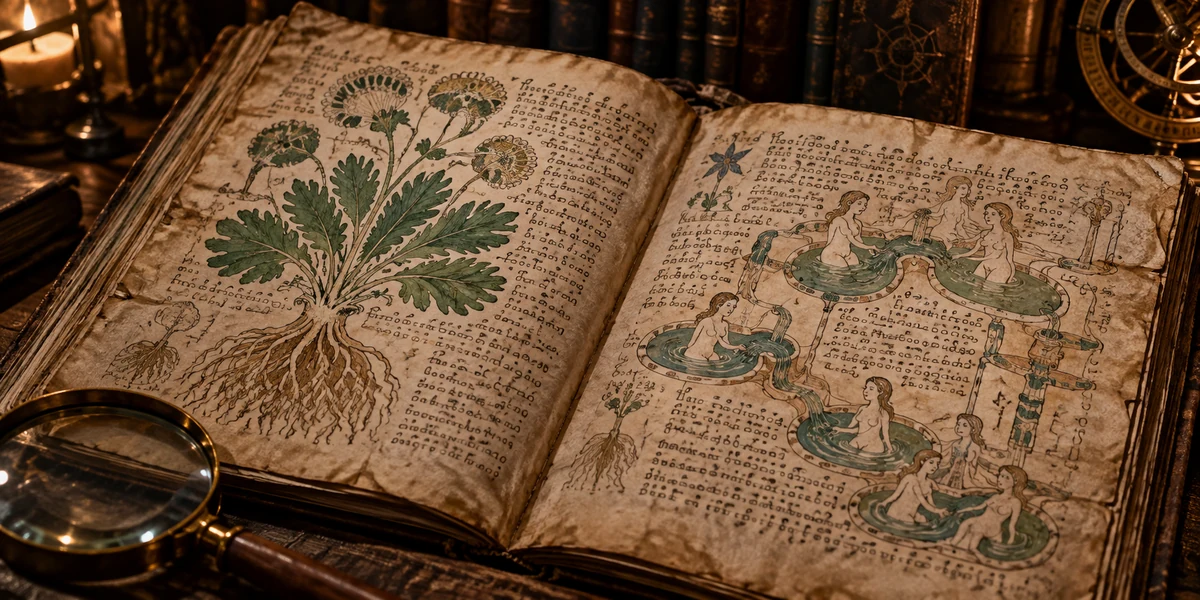
For more than 500 years, a strange illustrated manuscript has guarded a secret nobody has managed to uncover. Its pages are filled with an unknown language, drawings of plants that seem to come from another world, and mysterious figures bathing in pools connected by twisting pipes.
Now two researchers believe they’ve found an important clue, and it has nothing to do with breaking the manuscript’s code. Someone centuries ago may have put its pages in the wrong order, leaving generations of readers trying to make sense of a book that was never meant to be arranged that way.
A Book Nobody Can Read
The Voynich manuscript is one of history’s most puzzling books. Nobody knows who wrote it, what its strange alphabet means, or why it contains such an unusual collection of illustrations. The parchment has been dated to between 1404 and 1438, placing its origins in the early fifteenth century. The writing may have been added around that time, although the parchment’s age cannot establish exactly when the words were written.
The book takes its name from Wilfrid Voynich, a rare-book dealer who purchased it in Italy in 1912. Today, it is preserved at Yale University’s Beinecke Rare Book & Manuscript Library, where it continues to attract historians, linguists and codebreakers.
Its pages contain roughly 38,000 words written in an alphabet nobody has successfully identified. The letters repeat in recognizable patterns, forming neat lines and paragraphs that resemble ordinary writing. The illustrations are just as puzzling. Some show plants with enormous roots, unusual flowers and leaves that don’t resemble familiar species. Others contain stars, circular astronomical diagrams and women standing in green pools connected by networks of tubes.
Several large diagrams unfold from the book, revealing intricate arrangements of symbols and pictures. Despite decades of study, nobody has produced a generally accepted translation.
The Pictures That Don’t Line Up
Medieval manuscript specialist Lisa Fagin Davis had spent years studying the Voynich manuscript when she noticed something unusual about its construction. Her earlier research had identified evidence of five different scribes. That suggested several people had worked on the book, but their handwriting wasn’t distributed in an obvious sequence. Pages written in one style were sometimes interrupted by another, only for the original handwriting to reappear farther along.
The pictures offered another clue. On certain pages, illustrations extended toward the inner edge of the parchment, where the sheets meet at the binding. But instead of continuing on the facing page, parts of the designs appeared elsewhere in the book.
Some drawings of flowing water and connected pools seemed to have been separated from the pages where they should continue. It was almost as though someone had taken a collection of drawings, shuffled them and bound them together without knowing how they originally fitted.
Davis teamed up with Colin Layfield, an information systems researcher at the University of Malta, to investigate whether the manuscript’s physical construction could explain these oddities. Their research led them to reconsider how the book might have been assembled.
The Problem With Folded Pages
Most medieval books were made by folding sheets of parchment in half, placing several inside one another and sewing the groups together. Each folded sheet is called a bifolium. A collection of nested sheets is known as a quire, and several quires can be joined to form a complete book.
Layfield and Davis believe the Voynich manuscript may originally have followed a different arrangement. Instead of being made from nested groups, it might have consisted of individual folded sheets intended to be read one after another. These separate units are sometimes called singulions.
That changes the order in which the pages appear. If someone took those independent sheets and later assembled them into ordinary medieval booklets, pages that originally followed one another could end up separated by many others.
The researchers suggest this may have happened during the manuscript’s early history. Whoever assembled it might not have understood the writing well enough to recognize the proper sequence. It could explain the interrupted illustrations and some of the unusual shifts in handwriting, but the researchers needed more than visual clues to investigate their idea.
A Computer Finds Another Clue
Layfield and Davis turned to a computer-based technique called latent semantic analysis, which searches for patterns and relationships between groups of words. The method allowed them to compare sections of the Voynich manuscript without knowing what its mysterious writing actually meant.
They examined patterns across individual pages, folded sheets and larger groups of parchment. For comparison, they also studied known medieval works, including the Aberdeen Bestiary and the Speculum Humanae Salvationis. Their results suggested that the Voynich text often showed stronger connections within individual folded sheets than between pages that happen to face each other in the book today. That was consistent with the idea that the manuscript had originally been organized as separate units.
The researchers also tested alternative page arrangements in certain sections, looking for sequences that produced stronger connections between neighbouring pieces of text. Some of those arrangements showed better matches than the current binding. They published their findings in Digital Medievalist in July 2026, proposing that the manuscript’s physical arrangement could be hiding clues about how it was originally meant to be read. The results didn’t reveal a complete original page order, but they gave researchers a new way to approach the puzzle.
And there was another possible clue, one that had nothing to do with computers. An old water stain on the parchment might help reveal which pages once sat beside each other.
A Water Stain That Could Reveal the Original Order
Several pages of the Voynich manuscript carry a water stain near their upper edges. Davis believes its shape could help researchers determine which pieces of parchment were once next to each other. If water soaked through the sheets while they were arranged differently, the stain might preserve evidence of their earlier positions. The marks don’t always line up as expected in the present binding, making them another possible tool for reconstructing the book.
Unlike the computer analysis, this evidence doesn’t depend on patterns in the mysterious writing. It comes from the parchment itself, which has survived centuries of handling, numbering, rearranging and rebinding. Some original leaves are also missing entirely.
By comparing the folds, stains, handwriting and illustrations, researchers may eventually be able to work out how at least some sections were originally organized. Even if they succeed, however, the meaning of the manuscript’s strange language will remain an unanswered question.
What Was the Voynich Manuscript Originally For?
The new research raises possibilities about the people who created the manuscript and how they used it. Davis has suggested that the work of several scribes, combined with the unusual illustrations, could point toward a group preserving knowledge together rather than a single person writing a private book.
Some drawings resemble medieval herbal and medical material. Others suggest astronomy, astrology and subjects connected with women’s health. The separate sheets might once have been used for teaching, reference or sharing information within a community. The manuscript could have served a practical purpose that has disappeared along with the ability to understand its words.
Loose parchment can be damaged, scattered or lost, and binding the sheets together may have protected them through hundreds of years of history. Whoever assembled the book could have made it harder to understand while helping ensure it survived.
For centuries, scholars have searched its strange alphabet for answers. Now the physical pages may hold clues that nobody thought to look for before. The words haven’t changed in centuries, but the order we read them in might have.