
Unexplained Stories
Someone Invented Bitcoin, Sent 10 Coins to Hal Finney, and Disappeared
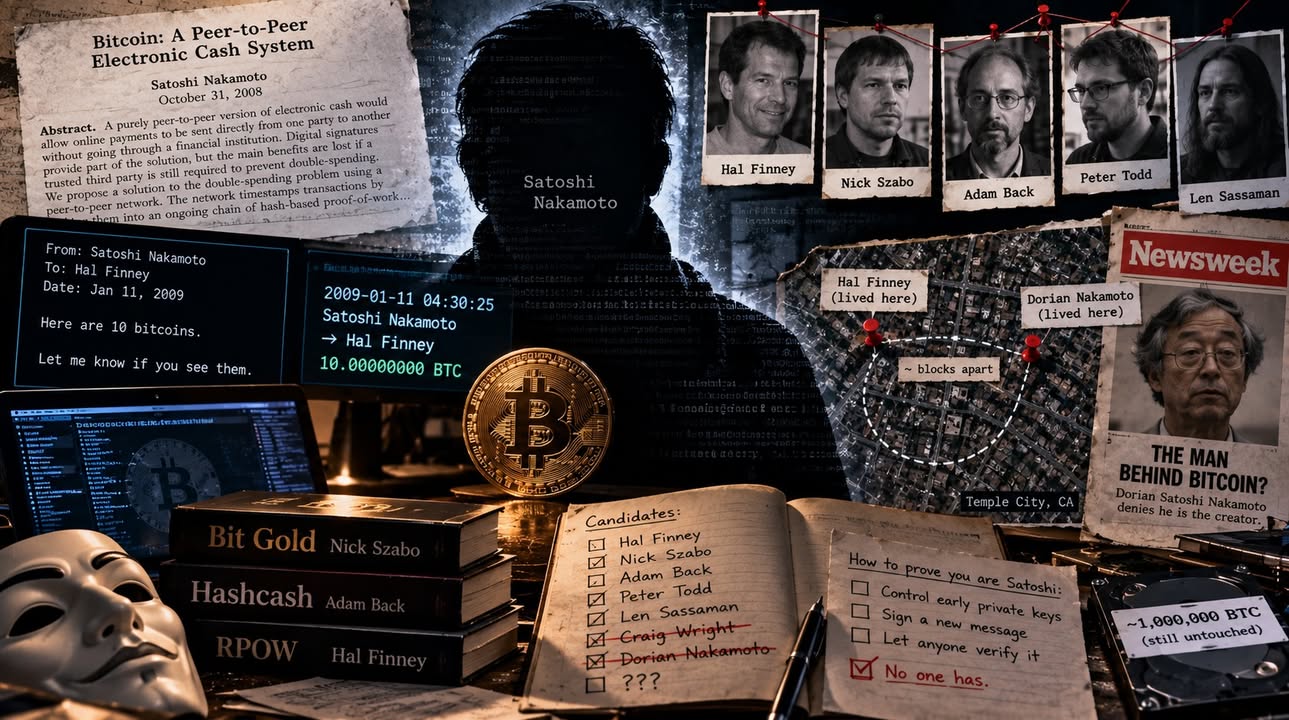
On January 12, 2009, a computer scientist named Hal Finney received ten bitcoins from someone calling himself Satoshi Nakamoto.
The coins were practically worthless. Bitcoin had only been running for a few days, and hardly anybody knew what it was. Finney was helping test a strange new form of digital money that could be sent directly between people without using a bank.
The transaction worked. The two programmers continued discussing the software and fixing problems.
But there was something unusual about the man who had invented it. Nobody seemed to know who Satoshi Nakamoto actually was.
Ten Coins for Hal Finney
Finney was already a respected figure in the world of computer security and cryptography. He had spent years working on ways to protect people’s privacy online, including technology that helped inspire Bitcoin.
When Satoshi announced the project, Finney was among the first people interested enough to download the software and try it. Bitcoin used a shared record called a blockchain. Instead of relying on a bank to keep track of everyone’s money, computers running the software worked together to maintain the record.
The ten-coin transfer was an early demonstration that the system worked. It was recorded in block 170, where it remains visible today.
Finney and Satoshi exchanged messages about technical problems, but their correspondence was entirely online. Finney would later become one of the most frequently suggested candidates for Bitcoin’s mysterious inventor. He denied being Satoshi.
A Man Nobody Had Met
Satoshi first introduced Bitcoin in a technical paper released in October 2008. The document described a new payment system that could operate without banks or a central authority controlling it.
Whoever wrote it understood several complicated subjects extremely well. The design brought together cryptography, computer networks, mathematics and ideas from earlier attempts at digital money.
Satoshi also knew how to write working software. When other programmers found bugs, he discussed the problems and helped fix them.
Yet he revealed almost nothing about himself. His online profile said he lived in Japan, but his writing sometimes used British spelling and expressions. There were no confirmed pictures, public appearances or reliable details about his personal history.
Nobody could establish whether Satoshi was one programmer, several people working together or someone using a fictional identity. And there was an intriguing connection buried in the history of digital money.
The NSA Had Been Studying Digital Cash
In June 1996, more than twelve years before Bitcoin appeared, three researchers at the United States National Security Agency produced a paper called How to Make a Mint: The Cryptography of Anonymous Electronic Cash.
Laurie Law, Susan Sabett and Jerry Solinas were investigating how electronic payments could work while protecting people’s identities. Their paper explored digital signatures, anonymous transactions and a particularly difficult problem: stopping someone from spending the same electronic money twice.
That was also one of the biggest obstacles Satoshi would tackle when designing Bitcoin. The NSA’s earlier system wasn’t Bitcoin. Its researchers were exploring different approaches to electronic cash, and some of those ideas were already being discussed outside government agencies.
But the paper revealed something remarkable. American intelligence specialists had been studying the mathematics behind anonymous electronic money long before a mysterious programmer introduced Bitcoin.
Another connection appeared in the software itself. Bitcoin uses a mathematical tool called SHA-256 to help secure its records and mining process. SHA-256 belongs to the SHA-2 family of cryptographic algorithms, which the NSA designed and which became a public federal standard in 2002.
That didn’t make Bitcoin an NSA invention. SHA-256 was freely available to programmers everywhere. Still, the agency had expertise in two areas that would become central to Bitcoin: digital money and advanced cryptography.
The Name Could Have Been a Cover
This is where one of the more fascinating theories about Satoshi begins. Suppose a government research group wanted to release an experimental financial network and see whether people would adopt it. Putting an intelligence agency’s name on the project might discourage the very programmers it needed to participate.
But releasing the software under the name of an independent developer would be different. A fictional identity could publish the technical paper, answer questions and work with early volunteers. Several people could even communicate through the same account, giving outsiders the impression they were dealing with one extraordinarily talented programmer.
Once the project had enough developers to continue independently, the people behind the identity could simply stop using it. Nobody has produced a document identifying Satoshi as an intelligence operation. The theory remains speculation, but it offers an intriguing possible explanation for the inventor’s extraordinary anonymity.
It also raises an interesting possibility: perhaps investigators have been searching for a person who never existed under that name.
The People Everyone Suspected
There were plenty of other candidates. Finney was an obvious one. He had the technical knowledge, was involved almost immediately and had developed an earlier system called Reusable Proof of Work.
Nick Szabo was another. Years before Bitcoin appeared, he had proposed a digital-money system called Bit Gold, which shared some important ideas with Satoshi’s design.
British cryptographer Adam Back also attracted attention. He created Hashcash, a technology that influenced Bitcoin’s mining system.
All three were capable programmers with connections to the same small community. But none has been established as Bitcoin’s inventor, and each denied being Satoshi.
Australian computer scientist Craig Wright went further, publicly claiming for years that he was the creator. In May 2024, Britain’s High Court issued a judgment rejecting his claim after examining extensive evidence.
The search continued, with investigators studying old messages, programming habits and technical similarities. Every candidate seemed to bring another argument, another contradiction or another person to investigate.
Satoshi Leaves the Building
By late 2010, Bitcoin was developing a life of its own. More people were downloading the software, and other programmers were taking responsibility for maintaining it. Satoshi gradually stopped participating in public discussions.
In April 2011, developer Mike Hearn received an email from Satoshi saying he had moved on to other things. He also said the project was in good hands with Gavin Andresen and the other developers. There was no elaborate farewell or public explanation of where he was going.
Soon afterward, the correspondence ended. Nobody could reliably identify the person who had launched the project, even as Bitcoin attracted increasing attention.
If Satoshi had been an independent programmer, he had walked away from an invention that would become enormously valuable. If he had been part of a team operating behind a fictional name, the withdrawal was remarkably clean.
The Fortune Nobody Claimed
During Bitcoin’s earliest days, mining was much easier because so few computers were participating.
Researchers studying the blockchain have identified patterns suggesting that one early miner may have accumulated an enormous number of coins. Some estimates put holdings potentially associated with Satoshi at hundreds of thousands of bitcoins, possibly approaching a million. Large groups of those early coins have remained untouched.
That has inspired plenty of theories. Perhaps Satoshi lost the passwords needed to access them. Perhaps the inventor died, deliberately abandoned the fortune or never intended to spend it.
Under the intelligence-agency theory, the silence becomes especially interesting. An organization developing experimental technology might have reasons for creating a financial network that had nothing to do with getting rich.
Bitcoin has a way for someone to demonstrate control of an early account. Whoever holds its private key can produce a digital signature that other people can verify.
A convincing signature from a key known to belong to Satoshi would be an extraordinary development.
Yet the person behind the name has never publicly established their identity that way.