Unexplained Stories
It Kept Pace With Their Car at 100 Miles an Hour. Its Eyes Glowed Red.
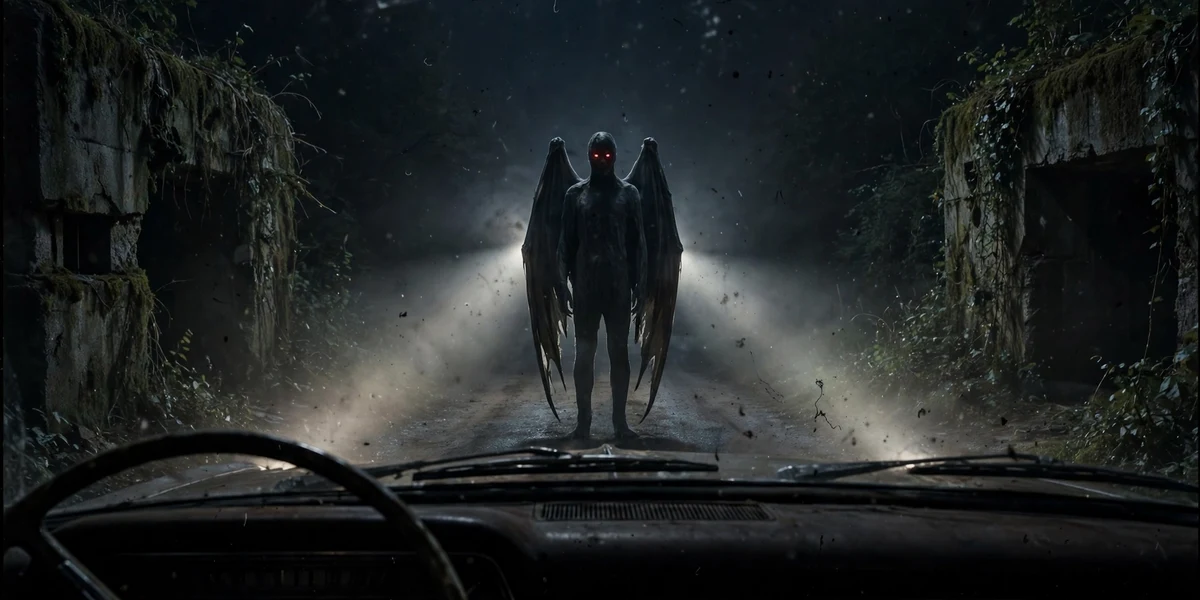
On the night of November 15, 1966, two young couples drove out past the old munitions plant outside Point Pleasant, West Virginia, and met something standing at the side of the road. Roger and Linda Scarberry were in the car with Steve and Mary Mallette. The plant had made explosives during the Second World War and had been sitting empty ever since — locals called it the TNT area, a maze of concrete bunkers and overgrown roads where teenagers went to be alone. The couples were cruising those back roads when their headlights picked up a figure.
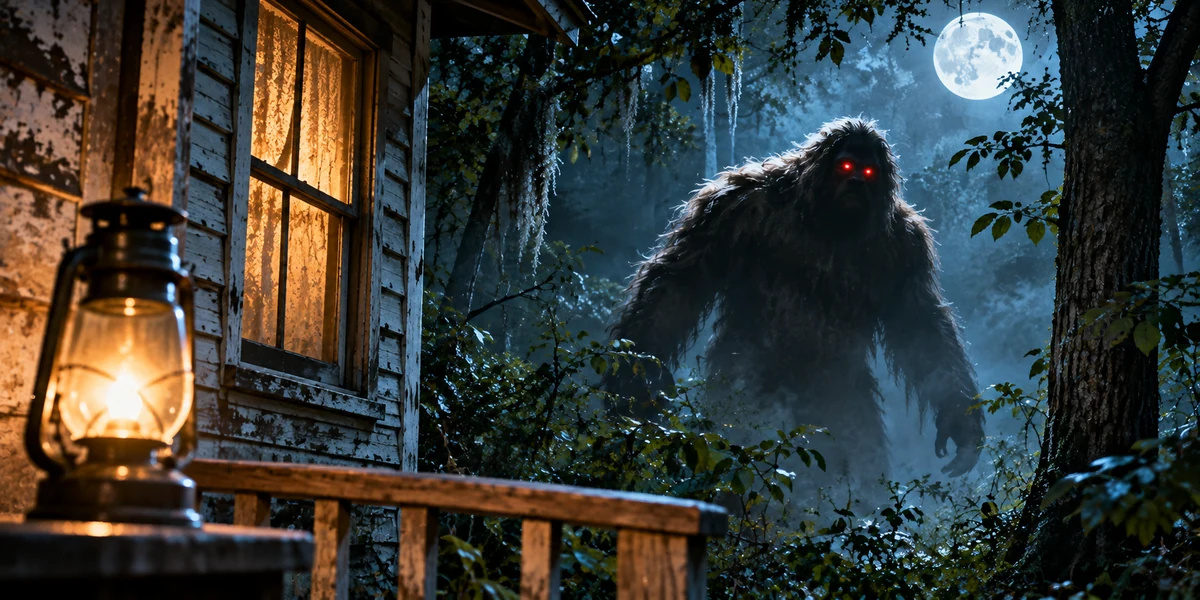
It stood six or seven feet tall. And its eyes, when the light hit them, glowed bright red. Linda Scarberry later wrote out what she saw for the police, and her description has never really been improved on. It looked, she wrote, "like a man with wings." Dirty grey in colour, with muscular legs like a man's, and "fiery-red eyes that glow when the lights hit it." She could not make out a face. There may not have been much of one to see — the eyes were the whole thing, and she said she could not look away from them.
Roger hit the gas.
A Hundred Miles an Hour Was Not Fast Enough
The thing rose straight up off the road "like a helicopter," spread wings that Linda judged at ten feet across, and came after the car. It did not flap its way up to speed like a bird. It simply kept pace, gliding alongside and overhead while the speedometer climbed to 100 miles an hour, and the couples could hear it screeching above the sound of their own engine.
It stayed with them all the way to the Point Pleasant city limits. Only there, at the edge of town, did it peel away and vanish into the dark. The four of them drove straight to the Mason County courthouse and told Sheriff George Johnson what had happened. They were not laughing. Deputies went back out to the TNT area that night and found nothing but dust kicked up where a car had gone past too fast.
The next morning the Point Pleasant Register put it on the front page under a headline that has to be the most honest piece of reporting in the whole file: "Couples See Man-Sized Bird… Creature… Something."
The Night Before, a Dog Had Already Gone
What the couples did not know, standing in that courthouse, was that something had happened the night before, a hundred miles north. Newell Partridge lived near Salem, in Doddridge County. On the night of November 14 his TV set started buzzing with a strange interference, and his German shepherd, Bandit, set up a howl outside and bolted toward the field, where Partridge's flashlight beam had caught two red circles glowing like bicycle reflectors. Bandit went after them at a dead run.
Bandit never came home.
Partridge searched the field and found the dog's paw prints going in circles, round and round in the dirt, and then simply stopping. He told reporters he believed whatever took his dog was connected to what the couples had seen — the red eyes were the same. It was the first of many times that winter that a West Virginian would describe those eyes to a stranger with a notebook.
A Town Full of Witnesses
Once the Register had the story, the reports came in a rush. Two volunteer firemen, Paul Yoder and Benjamin Enochs, said a large bird with red eyes had crossed their path. A gravedigger named Kenneth Duncan reported a brown, human-looking figure flying over him. On November 25, a Clarksburg shoe salesman named Tom Ury told police a huge white bird had paced his car at 70 miles an hour north of Point Pleasant. A young woman named Connie Carpenter said she saw it in broad daylight, close enough to be sure of the eyes.
Folklorist Jan Harold Brunvand, who studied the case for years, puts the usual count at a hundred or more people who reported seeing the creature across 1966 and 1967 — and notes there were likely plenty more who saw something and kept quiet about it, because they knew exactly how it would sound. The explanations arrived just as fast, and they have not changed much in sixty years. Sheriff Johnson reckoned the town was chasing a heron. A wildlife biologist at West Virginia University, Robert L. Smith, told reporters the descriptions fit a sandhill crane — a bird nearly as tall as a man, with a seven-foot wingspan and red skin around its eyes, blown off its migration route. Later writers settled on barred owls and their eyeshine.
Oh yeah. Another crane. The trouble with the crane is the calendar. A lost bird explains a strange weekend. Point Pleasant got thirteen months of it — in daylight, at arm's length, pacing cars at highway speed — reported by firemen, gravediggers, salesmen and sheriffs' own neighbours, in a county where everybody knew everybody and a liar would have been laughed out of the diner by Christmas.
December 15, 1967
The sightings did not fade away. They stopped, all at once, on a single evening. At about five o'clock on December 15, 1967, in the middle of the Christmas-shopping rush, the Silver Bridge between Point Pleasant and Ohio gave way and dropped into the Ohio River. Forty-six people died. Cars went off the broken spans in the dark, and the town spent that night and many nights after pulling its own people out of the water.
After the bridge, nobody in Point Pleasant wanted to talk about a monster. A local man put it plainly to a researcher years later: "The bridge was too real. A lot of prominent people went down on that bridge. You better not write about the Mothman anymore. There's something serious going on here."
Writers John Keel and Gray Barker later tied the two things together — the year of the red eyes, and then the worst night in the town's history — and Keel's 1975 book, The Mothman Prophecies, made Point Pleasant famous around the world. Whether the thing was a warning is a question the town itself has never settled. What is documented is the order of events: first the sightings, month after month — and then the bridge, and then silence.
What Point Pleasant Did With It
For a long time the town wanted the whole business forgotten. Then, slowly, it changed its mind. Point Pleasant now has the only Mothman museum in the world, opened in 2006 by Jeff Wamsley, a local man whose father worked at the old armory and who grew up hearing the stories at the kitchen table. A twelve-foot statue of the creature, all muscle and red eyes, stands downtown. Every year the Mothman Festival fills the streets of a town of fewer than 5,000 people with more than 15,000 visitors, who eat Mothman-shaped cookies and stand in line to hear the Scarberrys' story told one more time.
The witnesses are old now, and some are gone, and not one of the four people in that car ever took back a word of it. Whatever rose off that road in November 1966, it kept pace with them at a hundred miles an hour — and in Point Pleasant, in a way, it never did leave.